South Devon woke up on February 9, 1855, to fresh snow and a line of hoofprints running through it. Here and there, cloven. Single file.
If your house was in the way, it sometimes went over your house. At several others, the Times said, it walked up to the door, and then retreated.

Nobody saw it. At Clyst St George the rector's dog barked that night, and so did the neighbours' dogs, wherever the marks were later found.
Four Inches by Two and Three Quarters
Four inches long and a little under three across. About the size of your palm. Small, for a devil.
They fell eight inches apart, sometimes sixteen, and mostly in a single line. Most four-legged animals leave two lines of tracks, because they have two sides. A letter to an Exeter paper said these went alternate, like the steps of a man.
So: a hoof, walking like a man. In a Devon parish in 1855, that is a very short list.

A vast number of foot-tracks of a most strange and mysterious description — that is the Times, on February 16, under the headline Extraordinary Occurrence. It named five towns: Topsham, Lympstone, Exmouth, Teignmouth and Dawlish, and described the tracks of some strange and mysterious animal, endowed with the power of ubiquity.

Over the Rooftops
One account has the line crossing roofs and high walls, one of them fourteen feet high, without displacing the snow on either side or altering the distance between the feet. Near Exmouth, marks were reported on the sill of a window two storeys up. If you have ever been up on a roof in the snow, you will know that the usual stride up there is short, and ends in the garden.
The Western Times knew which part puzzled it most. Nobody could see where this visitor had got into the gardens, or where it had come out. The gates had been locked all night and some of the walls were seven feet high. At Lympstone, the Times said, there was hardly a garden without the prints. So if you lived in Lympstone, it had probably been through yours. It did not use the gate.
In one Devon field the hoofprints ran right up to a hayrick. Keep the hayrick in mind. The story reached the papers second-hand, from a scientific acquaintance of a local clergyman: the surface of the stack was wholly free from marks of any kind. On the far side, the prints began again.
Marks turned up on both banks of the River Exe, and the accounts describe that as a crossing of two miles of tidal water. There was a ferry at Starcross. It did not use the ferry. The Exe is also narrower than two miles, much of it dries out at low tide, and that winter, upriver at Exeter, people held a party on the ice. The two miles were reported, and never measured.
The same week, the army was freezing outside Sevastopol, the government had just fallen over it, and Palmerston had been prime minister since the Tuesday. The hoofprints turned up on the Friday.
At Exmouth, the Western Times reported a visit in the night from no less a person than His Satanic Majesty. At Dawlish, a party of tradesmen armed themselves with guns and bludgeons, set off from the churchyard to find the animal and destroy it, and followed the prints to Luscombe, Dawlish Water and Oaklands. They spent most of the day at it. They returned, in the words of the local paper, as wise as they set out.
A Kangaroo in the Wind
The Reverend Mr Musgrave, a retired clergyman living near Exmouth, preached at Lympstone church that Sunday. Much of the congregation was sure the devil had been through their gardens. His subject was Satan as a tempter. Partway through, according to the local paper, he gave it as his opinion that the hoofprints were a kangaroo's. By his own account it was a word in due season, and did good.
Here is the thing about the kangaroos. They existed. A gentleman named Thomas Fish kept a menagerie at Knowle Cottage in Sidmouth, with buffaloes, gazelles, pelicans and kangaroos at large on the lawn, and on fine Mondays he let the public in, two till four.
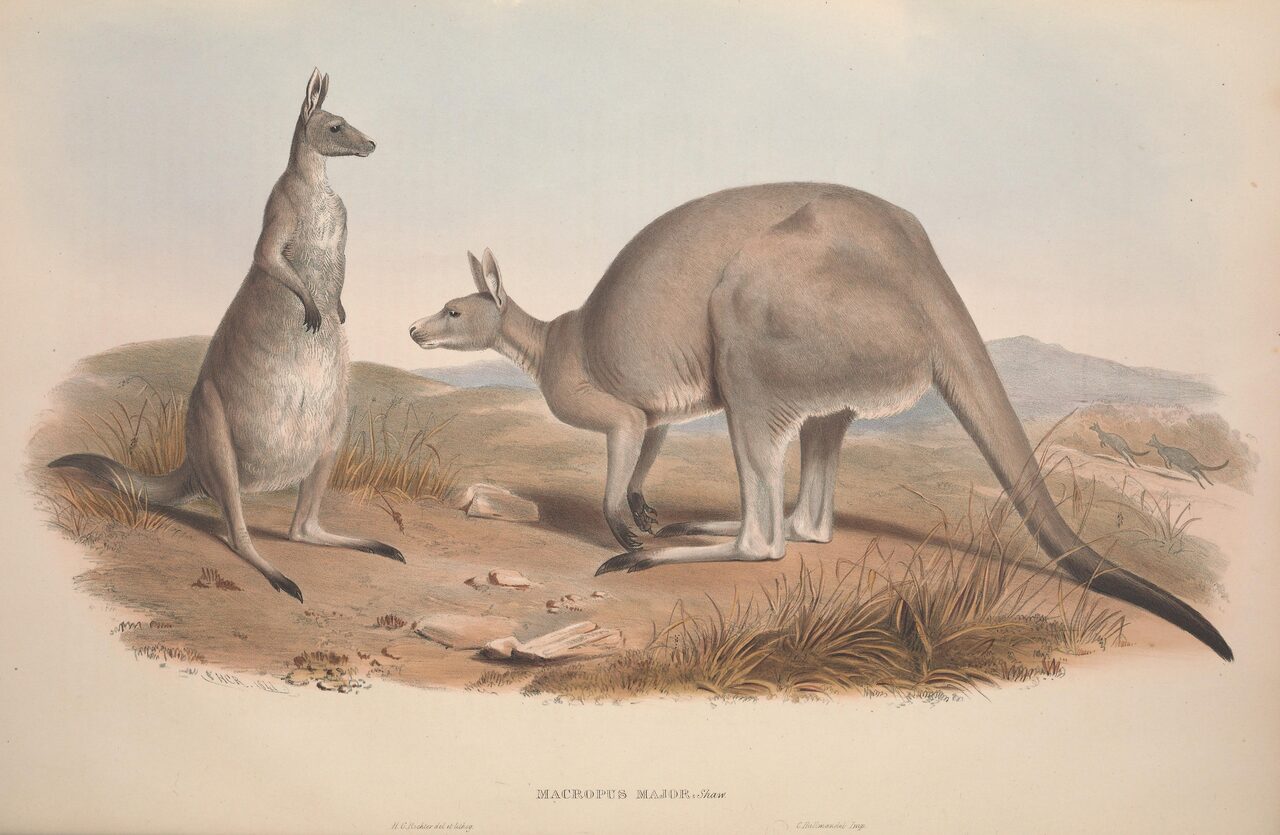
Nothing from 1855 shows one of them getting out. And the Times had ruled them out within the week, because the marks were found on both sides of the Exe. Nobody asked at the ferry.
Three weeks after the sermon, Musgrave explained himself in the Illustrated London News, signing with his initials. The kangaroos, he wrote, came from a report then current — a couple of them loose from a private menagerie at Sidmouth. His source for that, in full, was this: Mr Fish's, I believe.
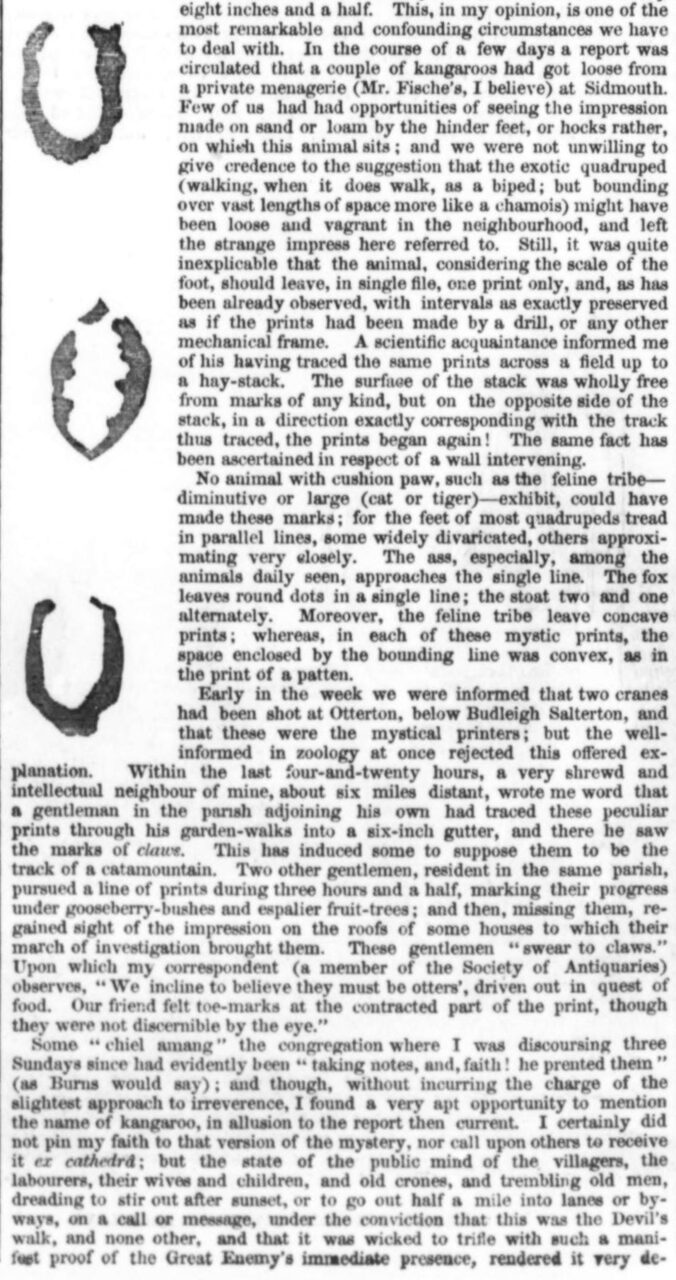
He added that he certainly did not pin his faith to that version of the mystery, nor call upon others to receive it ex cathedra.
He had his reasons. The villagers, he wrote, were dreading to stir out after sunset, under the conviction that this was the Devil's walk, and none other. If you were sitting in that pew, something had been through your garden in the night and you had a fair idea who. Then the man in the pulpit mentioned kangaroos. You took the kangaroos. As Musgrave put it: I was thankful that a kangaroo was in the wind.
He did not stay loyal to it either. Ten days after the sermon he told another clergyman privately that it was a crane, shot at Otterton. By the time he wrote to London, the well-informed in zoology had rejected the crane and he was leaning toward a bird of some unfamiliar tribe. Punch then announced that the Zoological Gardens had offered to show the worthy pastor a kangaroo, without expense, the first time he came to London.
Badgers, Rats, and Mr Fox
The serious attempts were not stupid.
In March a brewer and brick maker named Thomas Fox wrote in with diagrams. Rats had been at his brother's potato clamp, and the tracks around it looked so familiar that his brother announced the Devonshire donkey had been there. Fox's answer was rats: a rat bounding through snow lands with all four feet close together, and at the right depth the group comes out shaped like a donkey's shoe.
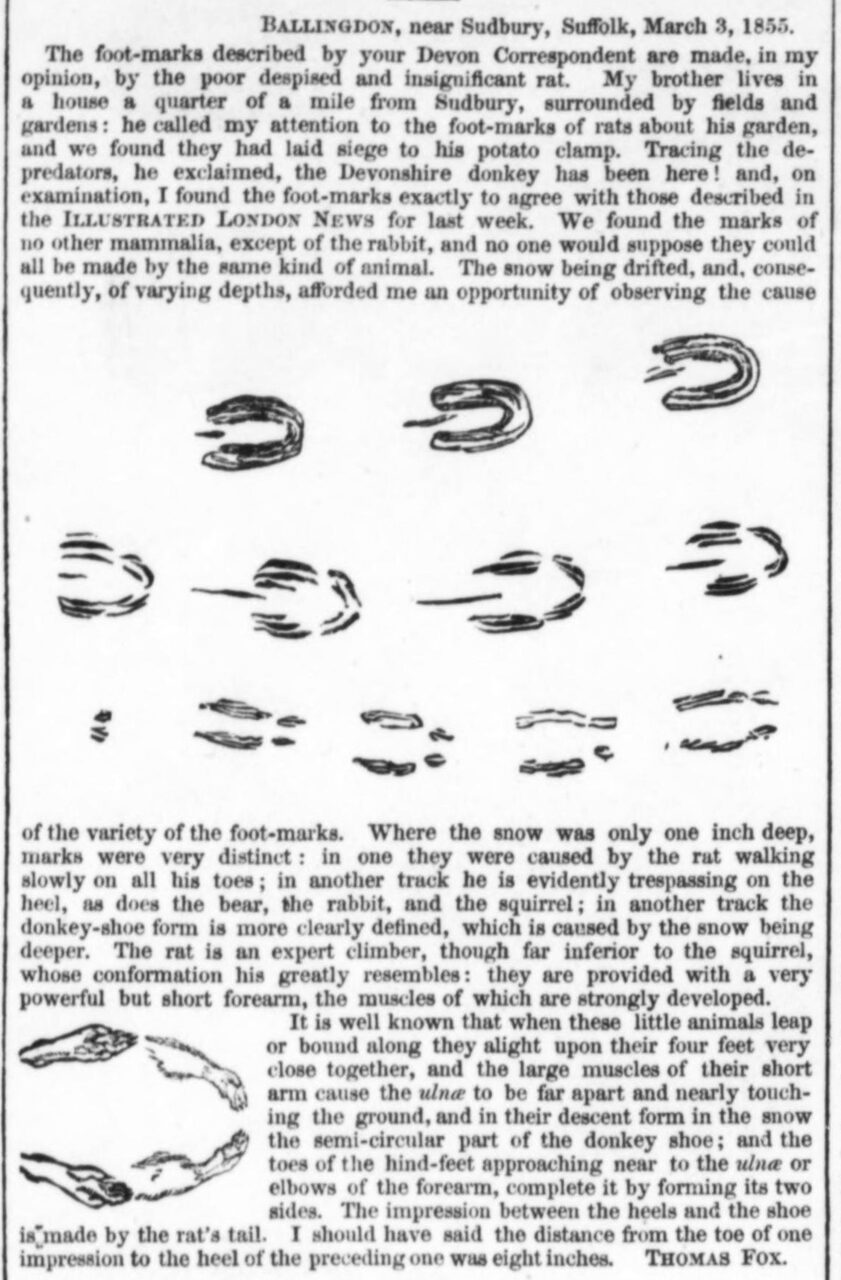
The file now had a Mr Fish, a Mr Fox, and still no animal.
You are thinking badger. So was Richard Owen, the man who coined the word dinosaur. He was sent a careful drawing of one print, from Luscombe, and decided on badgers. Several of them. It was unlikely, he wrote, that one badger only should have been awake and hungry.
Henry Ellacombe, the rector whose dog barked that night, went further, and posted Owen samples of the droppings found beside a trail. Owen's replies do not mention them.
The balloon took a century to arrive. In 1955 a reader of the Manchester Guardian suggested the marks were made by the trailing rope of a balloon which then floated out to sea. Thirty years later a Devon booklet brought it down near Honiton: an experimental balloon broke loose from Devonport dockyard trailing two mooring shackles, smashed some greenhouses, and somebody quietly hushed it up. That version came from a Major Carter, whose grandfather had worked at the dockyard. I would have asked who paid for the greenhouses. The 1855 record does not mention a balloon. It remains the most detailed account in the file.
The sceptics start pulling ahead with the weather. It had snowed heavily on the Thursday evening. Shortly after eleven it turned to sleet and rain, and by morning the ground was covered in a thin sheet of ice. A print that half-thaws and refreezes spreads, and changes shape. Much later a Dawlish woman recalled what a local farmer said he had seen between three and four that morning, out with his lambs: his cat's prints had half-melted and frozen again into the shape of a small hoof, with the claws still inside.
About that hundred miles. One letter-writer that February reckoned the actual progress must have exceeded a hundred miles, and the figure has been repeated ever since. The furthest anybody is known to have followed the prints was the Dawlish party. About five miles, with guns.
The thaw is the best single mechanism anyone has. But Mike Dash, the historian who collected the surviving accounts, did not think it could do the whole job. He concluded the cause was almost certainly multiple — some trails probably from donkeys and ponies, some from wood mice, and a few, possibly, from churchgoers making a point to their vicar. He also concluded that no one theory entirely explains the marks, and that the mystery remains. Both of those are his.
Here is the part nobody has ever made work. If the thaw turned ordinary tracks into hooves, it was choosy about it. The same snow, one witness wrote, held the marks of cats, dogs, rabbits, birds and men, all clearly defined. At Exmouth, people reported prints in the middle of a field with no approach and no retreat. And you have been keeping the hayrick in mind: clean on top, with the prints carrying on beyond it.
Every explanation covers a stretch of this beautifully, right up to the next garden wall.
What Survived the Thaw
For the sort of person who wrote to newspapers in 1855, it was a very good month. Naturalists, clergymen, a doctor, a brewer and at least one man with a toad wrote in, each with a different animal.

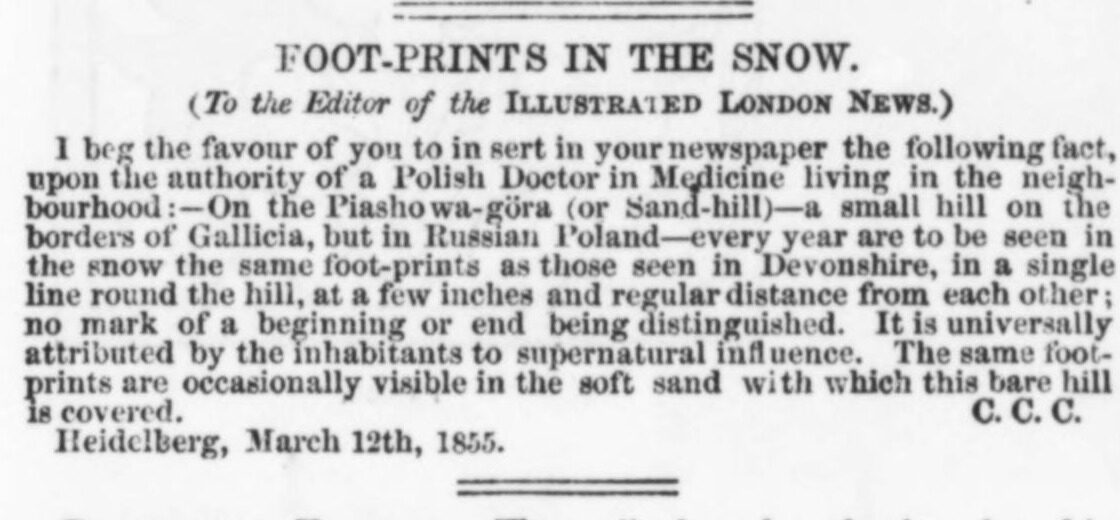
With the Devon hoofprints still in the papers, a letter arrived from Heidelberg. It passed on the word of a Polish doctor: on a small sand hill in Russian Poland, he said, the same marks appeared in the snow every year, running in a single line round the hill with no beginning and no end. The locals put them down, universally, to supernatural influence. Nobody in Devon had told them anything.
Nobody photographed the marks. Cameras existed in 1855, just not in a Devon village at short notice. No one took a cast either. They drew them instead: a sketch in the Illustrated London News from an eighteen-year-old, a facsimile that Musgrave swore was exact — he had checked that one — and several tracings among Ellacombe's papers at Clyst St George. The thaw came a fortnight later. A century after that, the tracings turned up in a box in the church.
Punch noticed what was happening to the drawings. Each correspondent who sends a facsimile of the marks, it observed, sends one utterly unlike that forwarded by anybody else, which naturally increases the mystery.
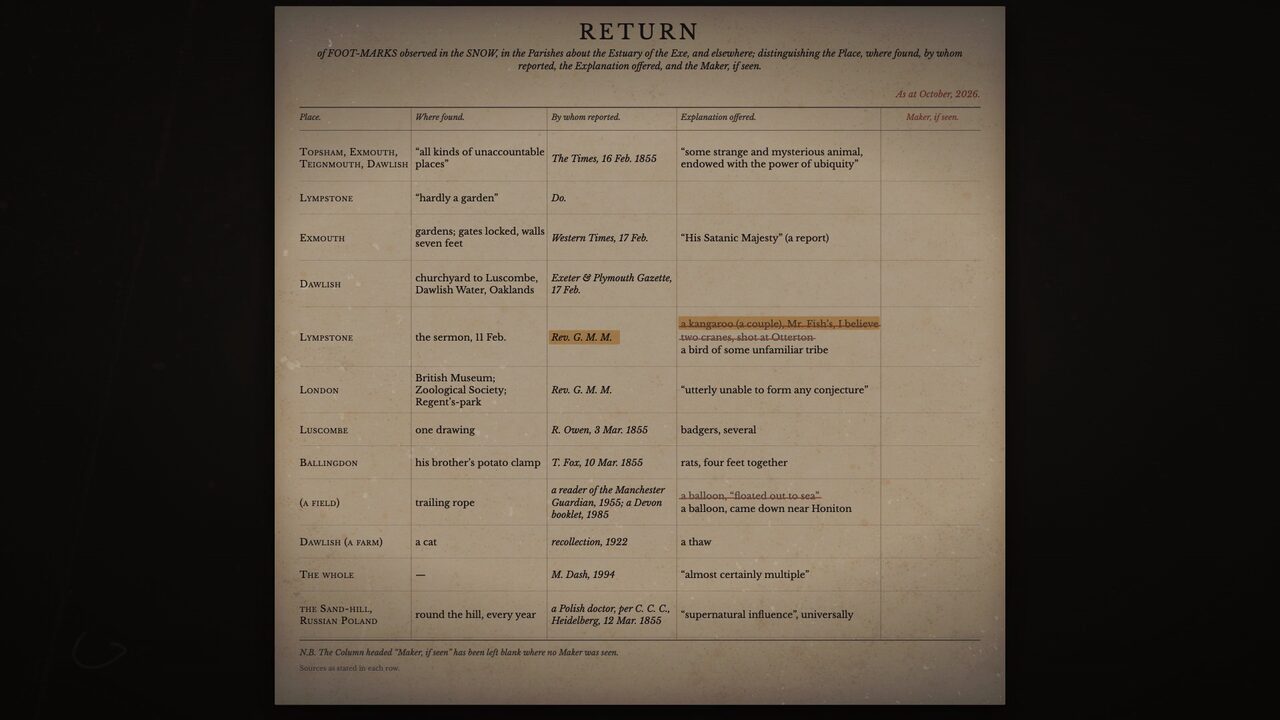
A hundred and seventy years on, the sceptics have the weather, the believers have the locked gardens, and the case sits about where the thaw left it. The tidiest answer anybody ever offered was a couple of kangaroos, from a man who admitted in print that he had never pinned his faith on them.
Nobody ever found where the line started, or where it was going.

If it snows in Devon this winter, have a look at the roof.
Sources & Case References
- The Times, "Extraordinary Occurrence," February 16, 1855
- The Examiner, February 17, 1855, including the editor's footnote
- Illustrated London News, February 24, March 3 and March 17, 1855 — the woodcut, Musgrave's letter, Richard Owen's letter, Thomas Fox's rat figures and the Heidelberg letter
- Western Times and Exeter and Plymouth Gazette, February 1855
- Punch, March 1855
- Mike Dash, "The Devil's Hoofmarks: Source Material on the Great Devon Mystery of 1855," Fortean Studies 1 (1994)
- White's History, Gazetteer and Directory of Suffolk (1855), for Thomas Fox of Ballingdon
- The Ellacombe papers, Clyst St George
- Image credits: Devon thatch under snow — Anna R Matthews, CC BY-SA 4.0. Public-domain figures courtesy the Illustrated London News, The Examiner, Punch, and John Gould's The Mammals of Australia. Unmarked figures are frames from the film.