Nine experienced hikers cut their way out of their own tent, from the inside. They headed off into the dark, most of them in their socks. It was a February night in 1959, on an open mountain slope in the northern Urals, far below freezing.
Nine people died on that mountain. That much the Soviet Union was willing to write down.
Earlier, they had put out a joke newspaper called Evening Otorten. Its science section reported that, according to the latest data, snowmen live in the Northern Urals, near Mount Otorten. They were on their way to Mount Otorten.
On the question of why they died, the Soviet Union offered one sentence. Everyone else has spent sixty-seven years arguing about what it left out.
Kholat Syakhl
The group was led by Igor Dyatlov, twenty-three. Most were students or graduates of the Ural Polytechnic Institute, cleared for the hardest category of trek the Soviet system had. The trip was, reportedly, dedicated to the Twenty-First Congress of the Communist Party. Nobody wandered up there unprepared.
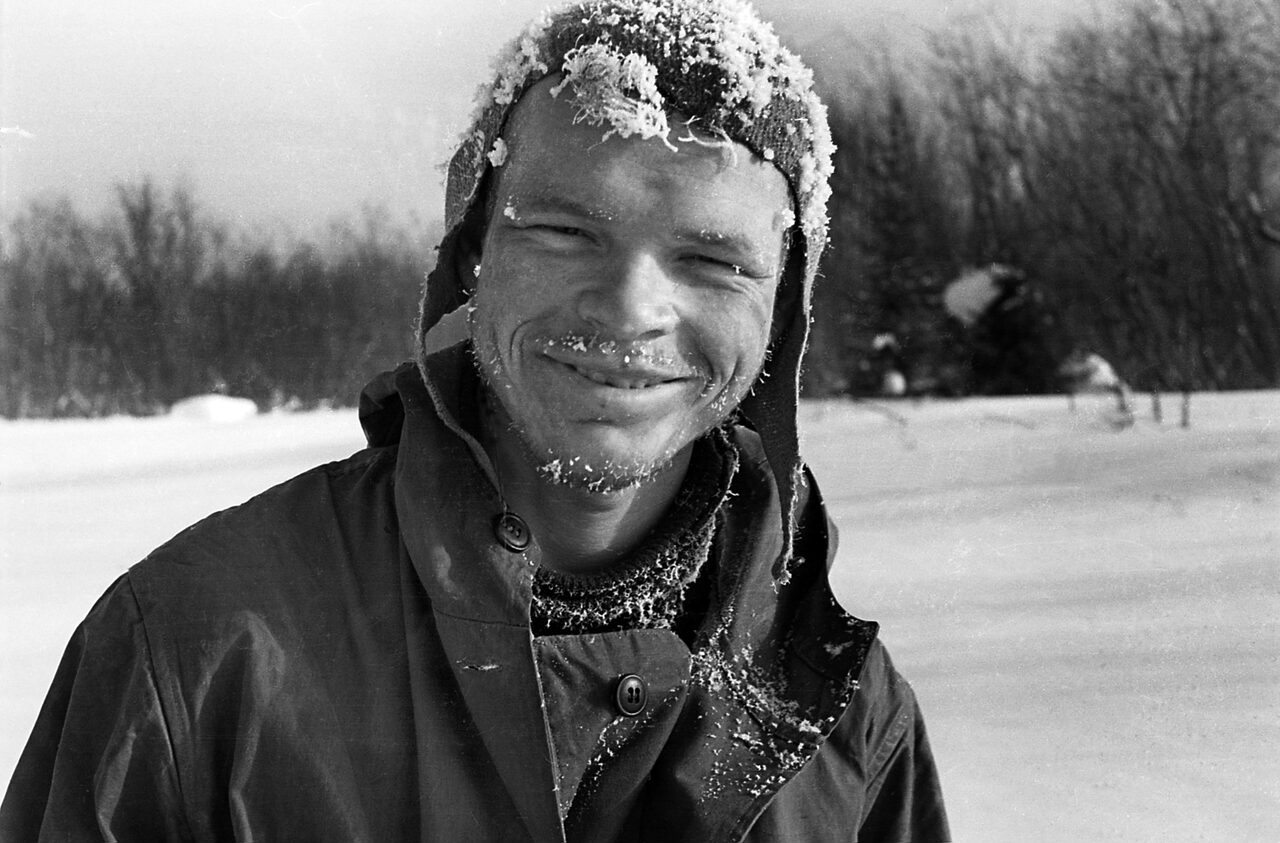
Ten people started the hike and only one came home. Yuri Yudin turned back on January 28 at an abandoned geological prospecting settlement — the Second Northern, empty since 1952 — with a bad leg. Sciatica saved his life. The day before, while they waited for a horse, Lyudmila Dubinina wrote in her diary: so, from here on, there will be nine of us.
We know their last days well, because they kept diaries and took photographs. Their newspaper's sports page reported a new world record, set by Yuri Doroshenko and Zina Kolmogorova, for assembling the stove. One hour, two minutes, twenty-seven point four seconds.
On February 1 they climbed onto the slope of Kholat Syakhl and, rather than camp lower in the trees, pitched the tent on the open slope in a spot that looked sheltered from the wind. Armchair mountaineers have been second-guessing it ever since. The last frame on one camera shows them digging into the snow, cutting out a level place for the tent.
Keep that cut in mind.
During the night something happened in or around that tent. We do not have their account of it. We have only what they did next, and the searchers had to read that in the snow.
Cut From the Inside
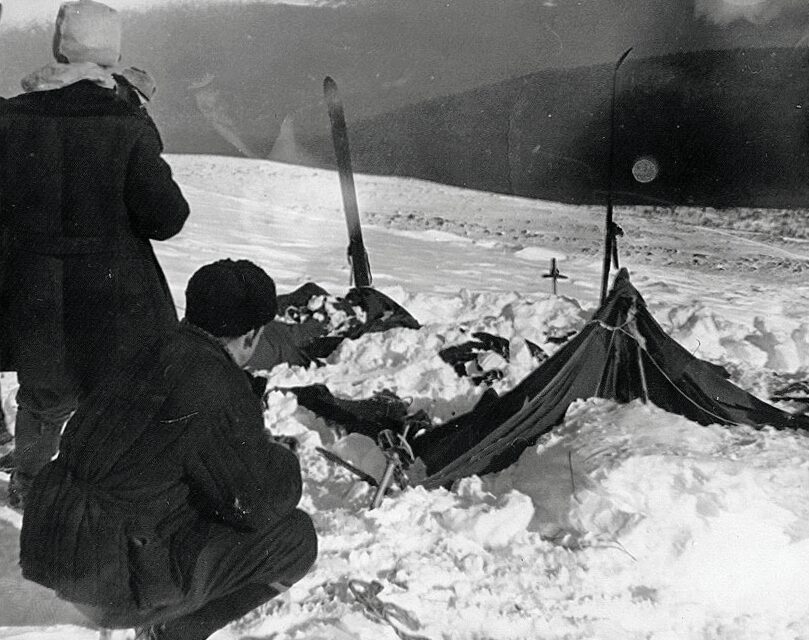
Dyatlov was due to send a telegram by February 12. It never came. On February 26, two student searchers, Mikhail Sharavin and Boris Slobtsov, found the tent half collapsed and buried in snow. A flashlight lay on top of the canvas. Slobtsov switched it on and it worked. The tent was empty. Their boots and coats were still inside.
It had been opened the wrong way. Cut from the inside, with a knife, on the leeward side where their heads had been.
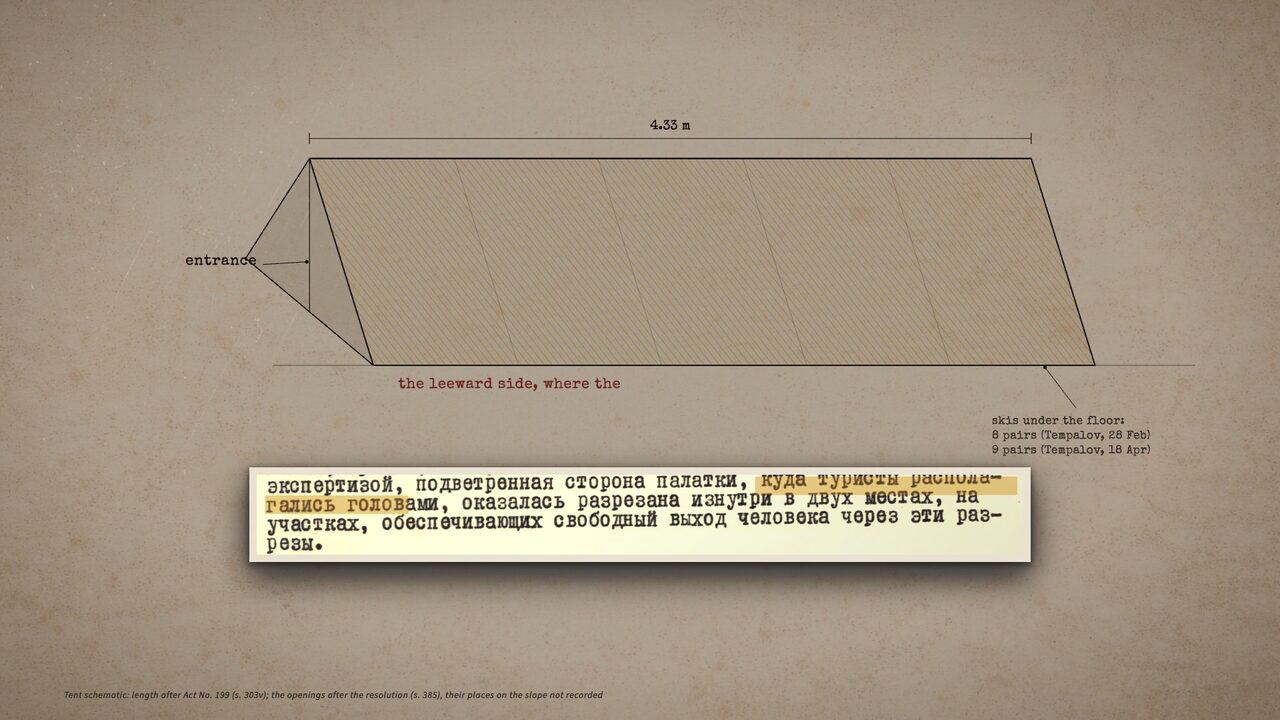
The closing resolution records two cuts, each large enough for a person to get out through. The forensic examiner who measured the canvas in April counted three, of roughly 32, 89 and 42 centimetres — the shortest of which is nobody's doorway. The head of the search told investigators that some emergency had made the tent more dangerous than a night half-naked in the snow. Why they had cut their way out, he could not explain.
From the tent a trail of footprints led downhill. Bare feet, socks, a felt boot, pressed into the snow. The prints suggested walking, not running, in a loose group. They went down about a mile, toward the trees. An orderly retreat, by people freezing to death.
At the treeline, by a tall cedar, they found the first two, in their underclothes. Branches were broken high up, as though someone had climbed to look back at the slope. There were the remains of a fire — a fairly decent one, the head of the search wrote, burning perhaps an hour and a half. They had tried to survive. They were not dressed for it.
Three more lay between the cedar and the tent. Dyatlov himself was about three hundred metres up from the cedar, on his back, one hand around a small birch. The three were strung out in a rough line toward the tent, as if trying to get back to it. The examiners put all five deaths down to the cold.
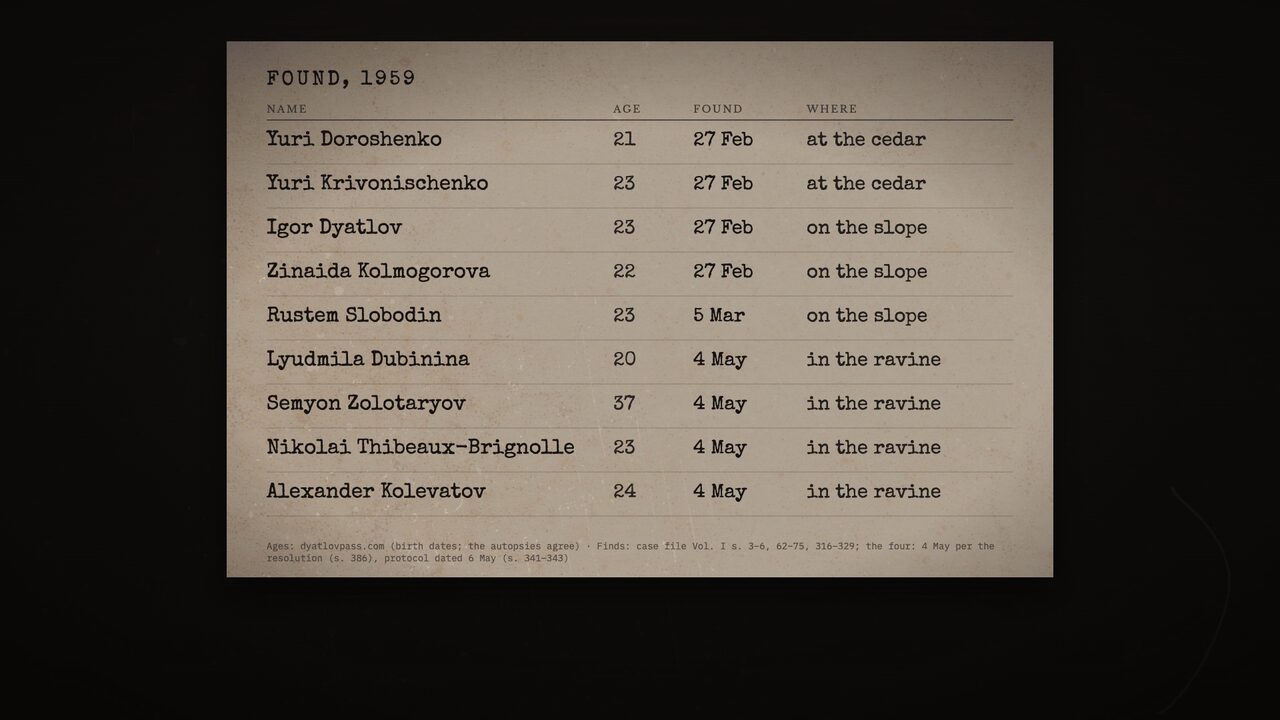
Five of the nine accounted for. The other four made it a legend.
The Ravine
The last four were not between the tent and the trees at all. For months the snow kept them, and they were found on May 4, in a ravine near the cedar, under deep snow, in a stream. Nearby they had dug a den into the snow and floored it with cut fir branches. These four were better dressed than the first five, partly in clothing cut from the two who died first. The living had taken what the dead no longer needed.
Three of them had been badly hurt, and not by the cold. Two had major chest fractures. One had a serious skull fracture. The examiner compared the skull injury to being flung by a car at speed. For the chests he said a force of roughly the same order — and, asked how injuries like that could exist with the skin unbroken, he reached for something else.
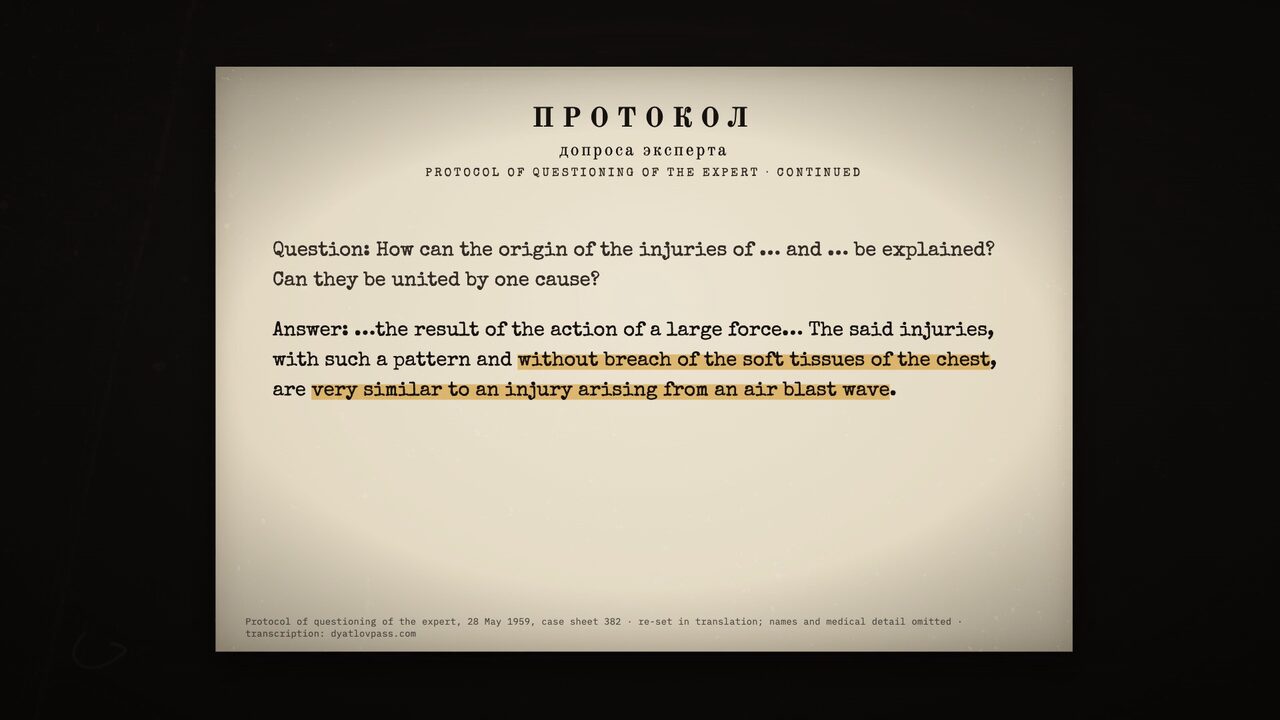
Something had struck them very hard without breaking the skin.
One detail, more than any other, built the legend. One of the women was found with significant soft-tissue loss to her face, and for decades people retold it as mutilation. The record is plainer and sadder than that. She had lain in a stream, under snow, until May. The examiner's conclusion describes post-mortem change in a body that had, lately before its discovery, been in water; the investigator's own question to the radiologist assumed about fifteen days in running water. He put the damage down to the water and the time, and he wrote that in 1959.
Then there was the radiation. Some of the clothing tested radioactive, in places above the norm for people who work with radioactive material, the city's chief radiologist said. The investigator, Lev Ivanov, had ordered that test himself, in May, to help establish the cause of death. In July he took the radiation pages out of the file as not relevant to the case.
The investigation had been given until May 28. It closed on May 28. Ivanov's file held a tent cut from the inside, five people frozen between the tent and the trees, and four in a ravine, three of them badly hurt. He explained all of it in one sentence.
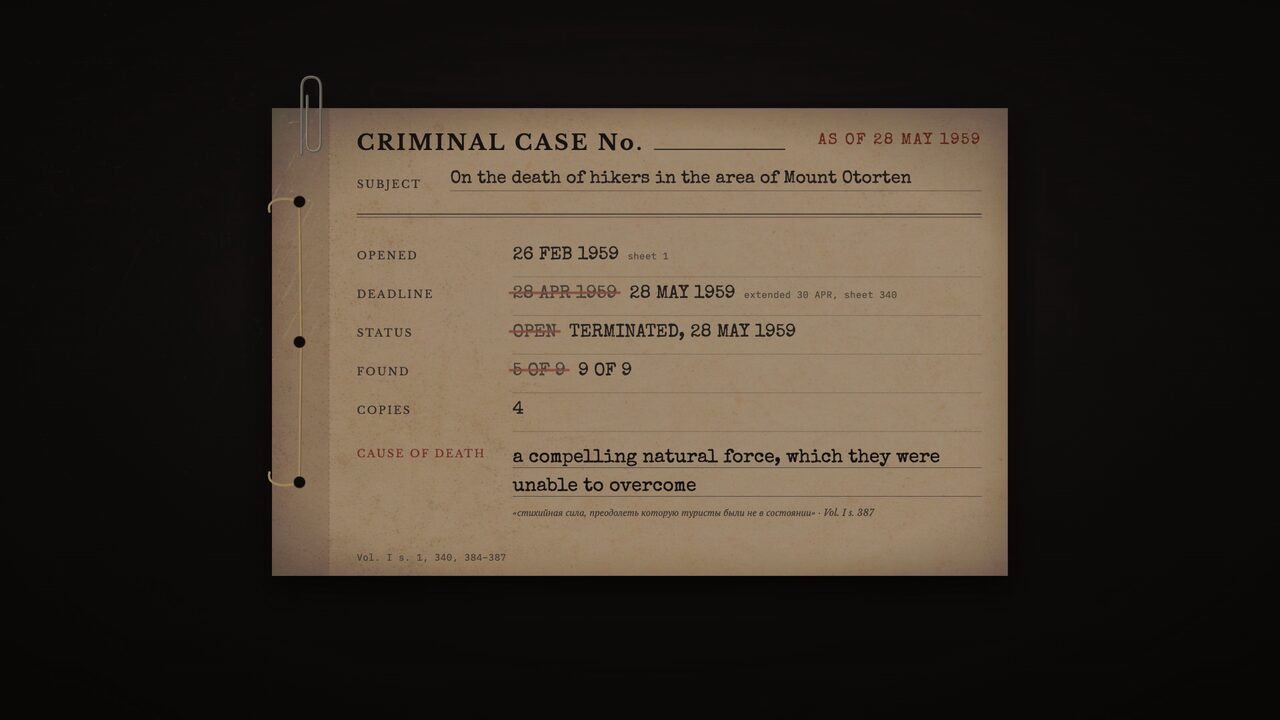
The hikers had died as a result of a compelling natural force which they were unable to overcome. The reasoning: no external injuries on the bodies, no signs of a struggle, and nobody had taken their money. No name for the force. No mechanism.
The same document found people to blame. Five officials were disciplined by the Party and the head of the institute's sports club lost his job, for shortcomings in organizing tourist work and weak oversight. It added that those shortcomings had no causal connection to the deaths.
Then the file went into a secret archive.
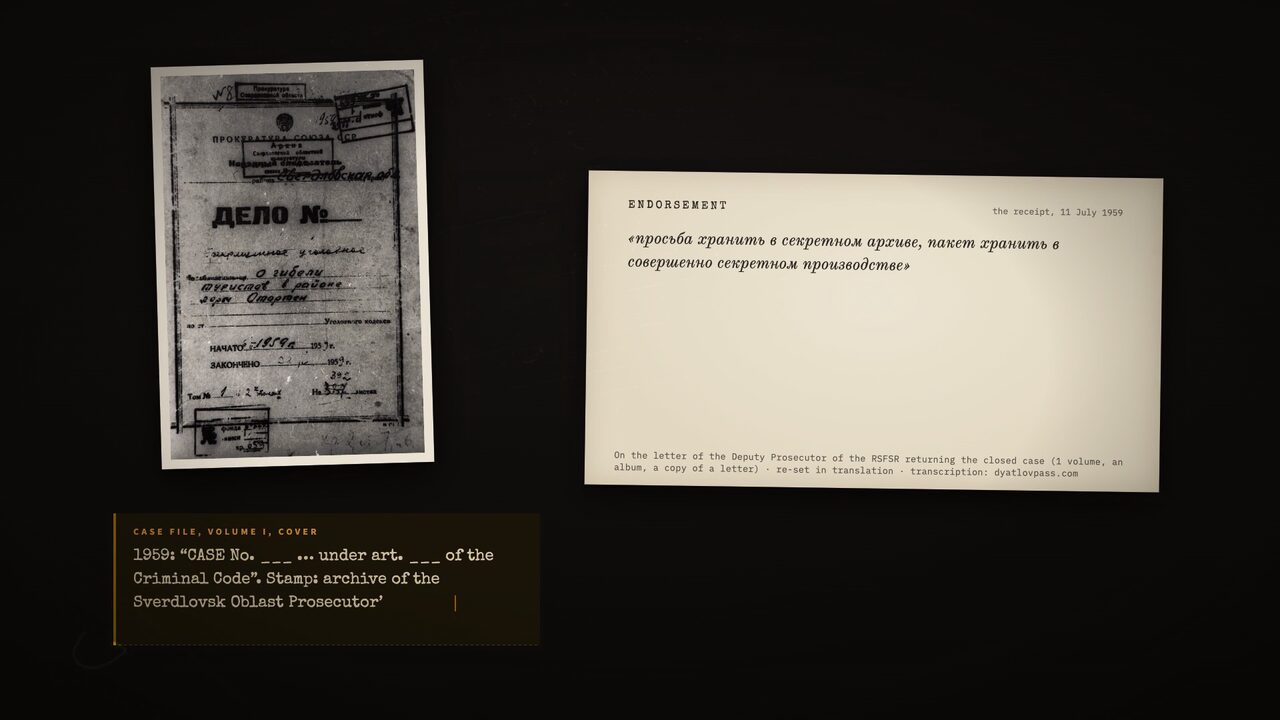
Nothing breeds a monster like a locked drawer.
Fireballs
Twice that winter, lights in the sky made it into the case file. In February another ski group saw a huge, milky disc of light. On March 31 a search camp radioed headquarters: at four in the morning the man on watch noticed a large fiery ring, which for twenty minutes moved toward us, then hid behind height 880. We ask you to explain this phenomenon, and its safety. Missile launches from Kazakhstan probably explain both.
The investigator who closed the case had a theory of his own. Thirty-one years later, in a newspaper in Kazakhstan, Ivanov published it under the title The Mystery of the Fireballs. He wrote that even in 1959 he had believed an unknown flying object killed the hikers, and that a senior Party official had ordered him to classify everything, seal it, hand it to the special unit and forget about it. He apologised to the families for hiding the truth from them.
Investigators had suspected the local Mansi first, and cleared them. Kholat Syakhl, reportedly, just means nothing much grows up there. The official verdict adds that among the Mansi it is considered no good for reindeer.
The military theory has a real toehold: the state was test-firing missiles that winter, and it lied as a matter of routine. The parachute mine theory never took off. The rest of it needs a cover-up that looks exactly like weather.
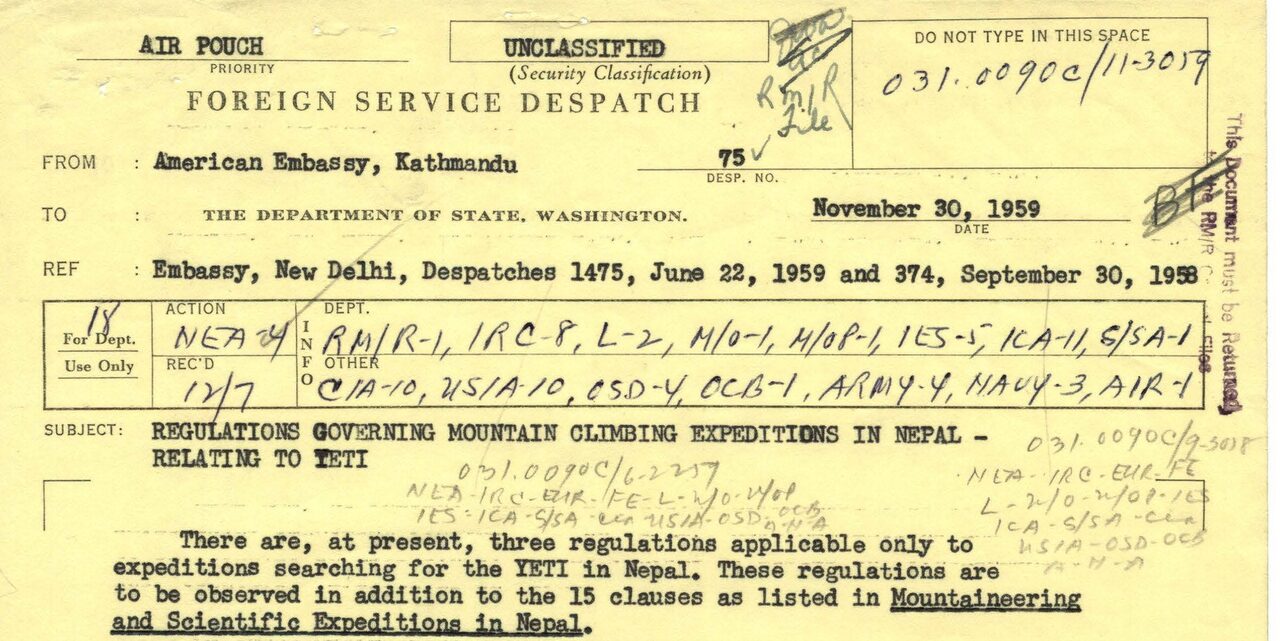
A book in 2013 blamed infrasound, from wind over the ridge, for panicking them out of the tent. The infrasound theory never really resonated. The snowmen from the joke newspaper got a theory of their own: in 2014 the Discovery Channel aired a two-hour special, Russian Yeti: The Killer Lives. The yeti one was, by any measure, abominable.
By then a horror film had already come out. A year later came a video game narrated by Sean Bean. From four words in a locked drawer, the whole thing snowballed.
The Other Cut
In 2019 Russian prosecutors took another look. They counted about seventy-five versions and kept three: an avalanche, a slab of snow, and a hurricane. The hurricane theory, eventually, blew over. In July 2020 the prosecutor in charge announced an avalanche and said the question was closed. A month later the Prosecutor General's office formally disciplined him. He had been speaking, his superiors said, for his dissertation.
Disney's Frozen helped two scientists test the avalanche theory. One of them had admired the film's snow so much that he went to Hollywood and adapted the code that animated it. The one with the snowman. In 2021 he and a geotechnical engineer proposed a slab avalanche — a small, delayed one, not the roaring wall of snow people picture. Their paper concedes that an avalanche there would be unlikely under natural conditions. Its argument is that the hikers had changed the conditions.
In their model it starts with the cut. By carving into the slope to pitch the tent, they had undermined the snow above them. Through the night, katabatic winds — cold air pouring downhill — loaded that slope with drifting snow. At some hour the slab let go and slid onto the far end of the tent, away from the entrance. Onto people lying on their skis, on the tent floor.
A heavy slab pinning a body against a rigid surface could crack ribs with great internal force and leave the skin unbroken. The scientists calibrated their model with crash tests General Motors ran on cadavers in the 1970s. Even so, their paper allows that the chest injuries could have happened later, down in the ravine.
A year later two mountain guides went back to the pass for the scientists, in weather like that night's. The wind knocked their snowmobiles over several times. They photographed two fresh slab avalanches nearby, and within an hour blowing snow had nearly hidden one of them.
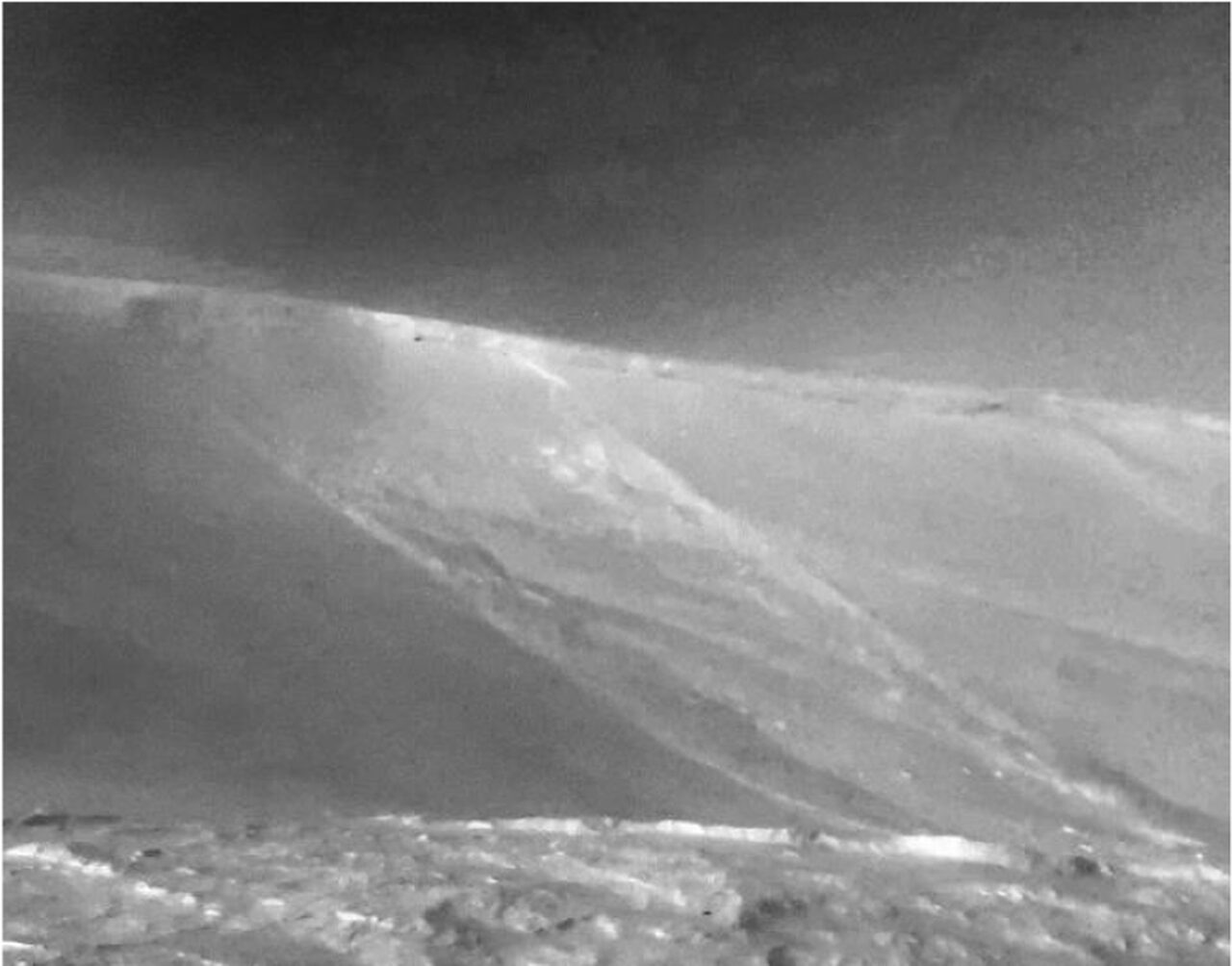
The next January they caught another, about seven hundred metres from the tent site. Which might explain why the searchers saw no sign of one.
Dead Mountain
The scientists themselves stop well short of a verdict. Solving the Dyatlov Pass mystery, they write, is an enormous task which is far beyond the scope of this paper. Their model does not touch the radiation — one of the group had worked at a secret nuclear plant, which might explain it.
And it leaves a fork. If the slab hurt them in the tent, the footprints show no sign of anyone being carried. If they were hurt later, in the ravine, nobody has shown how. People have proposed how. Nobody has demonstrated it.
The two students who found the tent ended up on opposite sides. Boris Slobtsov co-wrote a book arguing for an avalanche. Mikhail Sharavin died in 2020, still convinced it was something man-made. Yuri Yudin, who turned back, never believed in an avalanche either. Late in life he said that if he could ask God one question, it would be what really happened to his friends that night. This June, the relatives asked for a new criminal case.
Some Russian tabloids, the scientists noted, took their paper badly. Mysteries are more attractive while unsolved, or at least not solved with such a boring scientific explanation. Television agreed: in 2026 an Australian drama borrowed the premise and set it in the outback. There is less money in snow.
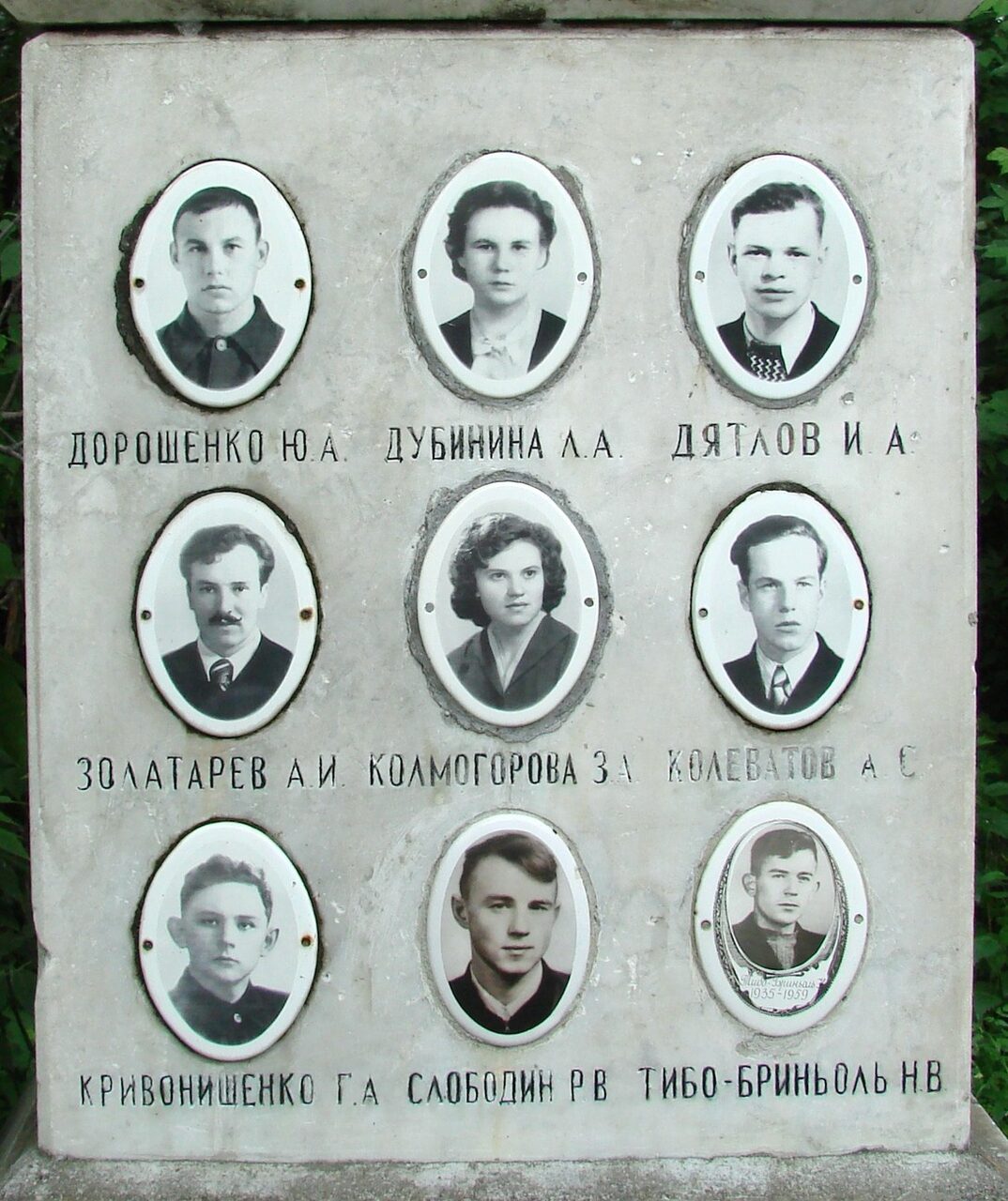
Nobody has ever found a monster on that mountain. There was snow, and wind, and a spot that looked sheltered. The Soviet Union wrote it up as a compelling natural force, sealed it, and went home.
Nine people went up a mountain. It took a superpower one sentence, and everybody else six decades, to blame the snow.
Sources & Case References
- Dyatlov Pass — scans and transcriptions of the 1959 criminal case file (Vol. I), including the closing resolution at sheets 384–387
- Protocol of questioning of the expert B. A. Vozrozhdenny, May 28, 1959, case file Vol. I sheets 381–383
- Forensic examination of the tent, Act No. 199, April 16, 1959
- Johan Gaume and Alexander M. Puzrin, "Mechanisms of slab avalanche release and impact in the Dyatlov Pass incident in 1959," Communications Earth & Environment 2, 10 (2021)
- Alexander M. Puzrin and Johan Gaume — follow-up field observations at the pass, Communications Earth & Environment (2022)
- Lev Ivanov, "The Mystery of the Fireballs," Leninsky Put (Kustanai), 1990
- Russian Prosecutor General's Office review of the case, 2019–2020
- Image credits: Igor Dyatlov, January 1958 — Pyotr Bartolomei, CC BY-SA 2.0. Slab avalanche at the pass, January 29, 2022 — Dmitriy Borisov, in Puzrin & Gaume 2022, CC BY 4.0, source. Public-domain records and photographs courtesy the Sverdlovsk Oblast Prosecutor's Office (case file), searcher Vadim Brusnitsyn (the tent), the American Embassy in Moscow (the 1959 despatch) and Dmitry Nikishin (the memorial). Unmarked figures are frames from the film.