On a Monday night in August 1977, a radio telescope in Ohio picked up the most famous candidate signal in the search for alien life. Nobody was there. A computer in a room underground printed it out, along with everything else, and kept going.
It reached a human being a few days later. The site technician dropped the printout off at a volunteer's house on his way into Columbus for supplies.
The volunteer, Jerry Ehman, went through the stack at home after supper, with a red pen. A few pages in, six characters in one column stood far above everything around them. He circled them, and in the margin, without thinking, he wrote one word.
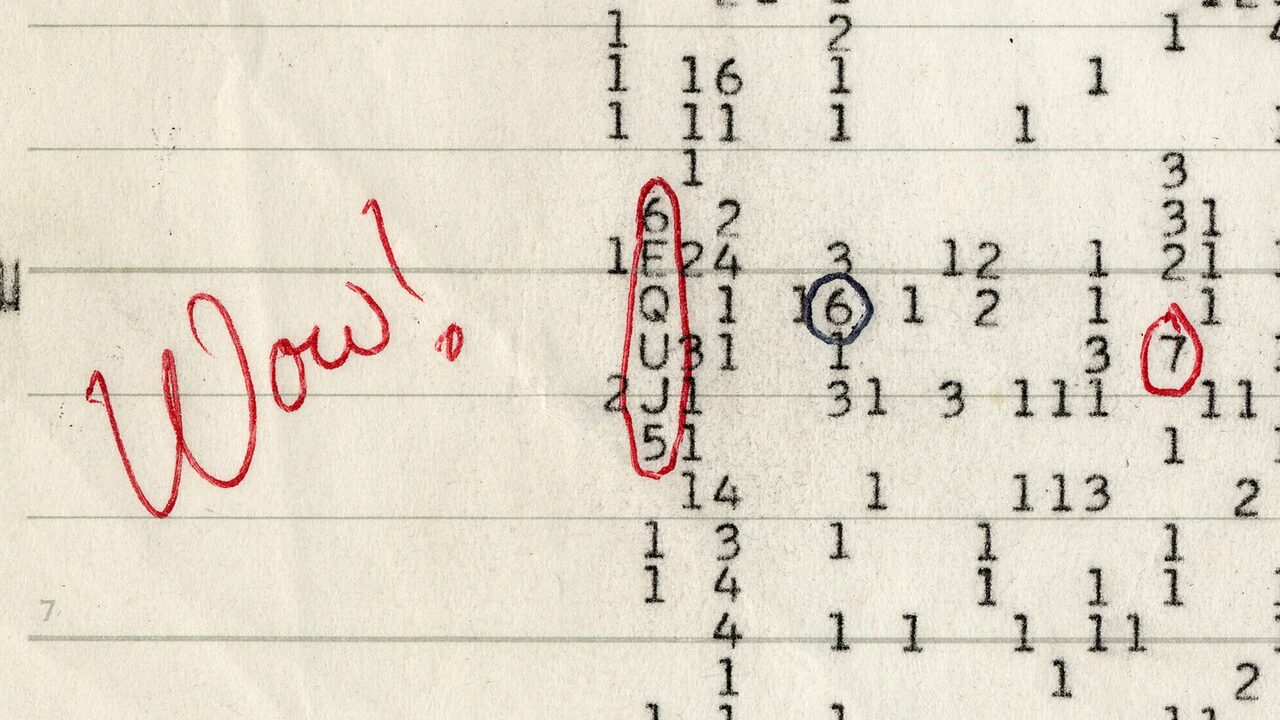
It has not been caught since. Much of the ground where the telescope stood is now a pond, on a golf course.
The Big Ear
Ohio State called its telescope the Big Ear. It stood on twenty acres that a different university, Ohio Wesleyan, let it use. It covered more ground than three football fields, and while it listened, none of it moved — the turning Earth swept the sky past it instead. Students built it, learning to weld as they went. Its designer, John Kraus, got the idea for tilting the big reflector from a Ferris wheel at the county fair.

In August 1972, the National Science Foundation phoned Kraus without warning. The money would stop in twenty-three days. The staff found other jobs, and some of them kept coming back, unpaid. In December 1973 they started listening full time for signals from other civilizations. Kraus wrote that there was no fuss or fanfare. Guinness later listed it under Longest Extraterrestrial Search.
What they were listening for had been specified fourteen years earlier. In 1959, two physicists picked the radio frequency aliens would most likely use to call us. Writing in Nature, they chose the radio line of hydrogen, which, they argued, must be known to every observer in the universe. A real message, they predicted, would run for years, and then repeat, from the beginning.
Nature ran their paper directly after one on predicting when bees will swarm by listening to the hive.
6EQUJ5
The Big Ear never recorded a sound. It printed. Every twelve seconds a line printer stamped out one row, and each row held a character for each of fifty channels, showing how far that channel stood above the background noise. A blank meant nothing. Digits meant a little. After nine, it ran on into the alphabet.
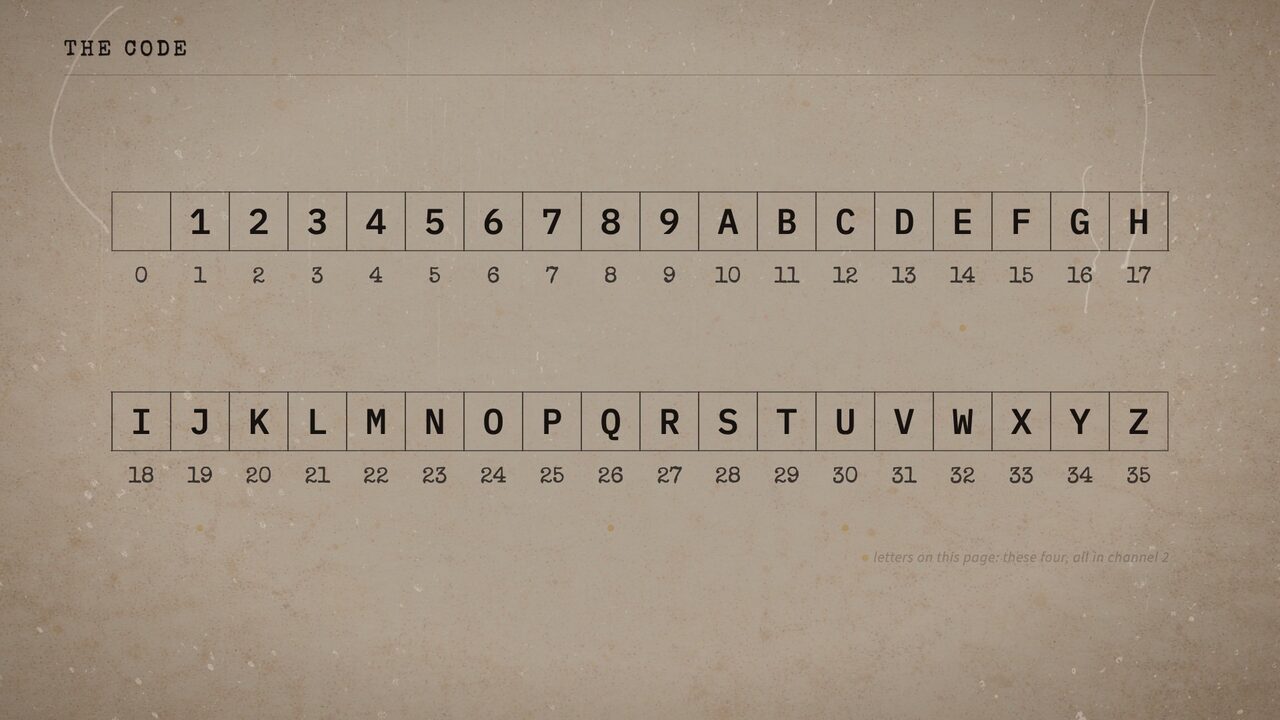
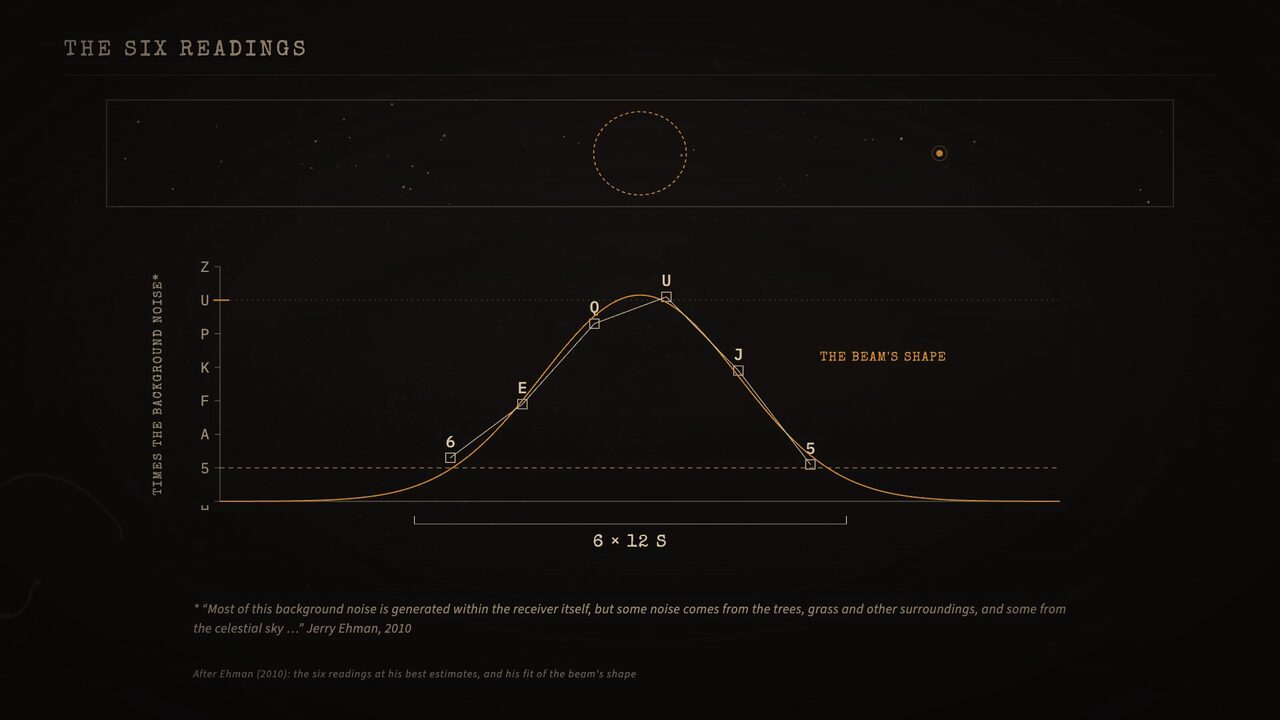
On the night of August 15, the telescope was looking low in the southern sky, toward Sagittarius. In channel two, the column read 6, E, Q, U, J, 5. Anything over about five was worth a look. The U meant roughly thirty times the background noise.
Plotted out, the six readings rise and fall over about seventy-two seconds, and the curve matches the telescope's beam almost perfectly. That is the curve a point fixed among the stars draws as the Earth turns.
Most natural radio sources smear across the dial. This one sat in a single channel ten kilohertz wide, with nothing above the noise on either side, and it came in a hair from the hydrogen line — right where the 1959 paper said to listen. Two years later Kraus described it in the observatory's own magazine. It had, he wrote, all of the characteristics that one might expect from an extraterrestrial beacon signal.
Set the prediction against the event and most of the form stays empty.
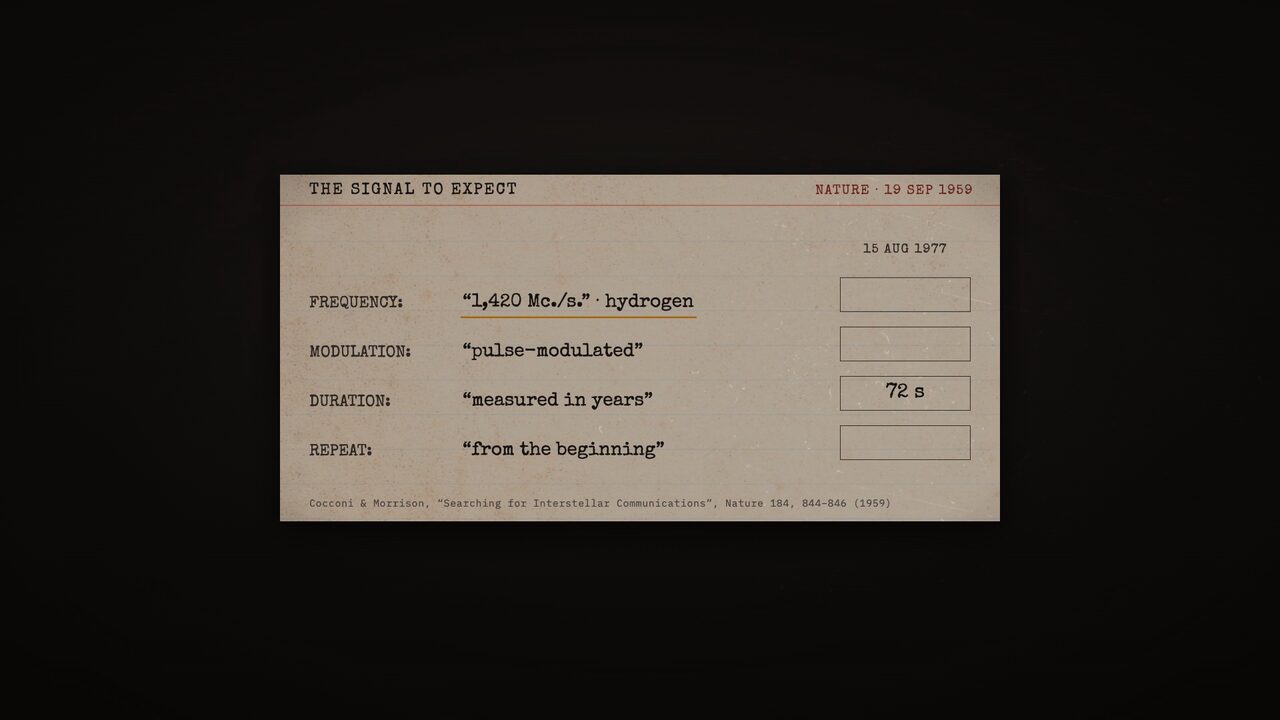
The telescope came with a built-in second opinion. It listened through two feed horns, side by side, so anything fixed in the sky drifts through one beam and then the other about three minutes later. The Wow came through once. And that August the printout did not record which horn heard it, so the signal has two possible addresses.
To Kraus, the single appearance was the significant part. So it was an on and off signal. Was it intended for us?
It Never Came Back
Before he told anyone, Ehman read the rest of the stack to see if it came back. It did not. Then came what Kraus called urgent discussions, and before long he was calling it the Wow signal. They checked the planets, the biggest asteroids, and every known space probe. So we drew a complete blank.
By then the telescope had already moved on. The survey had stepped to the next strip of sky before Ehman ever saw the page.
In mid-September they tilted the reflector back. They listened into October, and over the next few years the Big Ear made about ninety useful passes over that patch of sky — the rest were lost to clock, printer and power failures. Nothing. Other telescopes took up the search, most of them pointed there by Robert Gray, an independent searcher from Chicago. In Tasmania one blip turned up at the expected frequency for thirty seconds. Gray's team judged it too close to the noise to count.
Add up every published search since and it comes to about 192 hours. A little over a week. One statistical study concluded that a signal repeating at random still cannot be ruled out.
Bob Dixon, who ran the Ohio search, wondered about a secret military satellite, since military transmitters often ignore civilian agreements. Or perhaps, he wrote, it was a transmission from another civilization. If so, it seems that they were not trying very hard to attract our attention.
Golf Wins
Meanwhile the telescope had a neighbour. On federal survey maps from the 1960s it is already labelled.
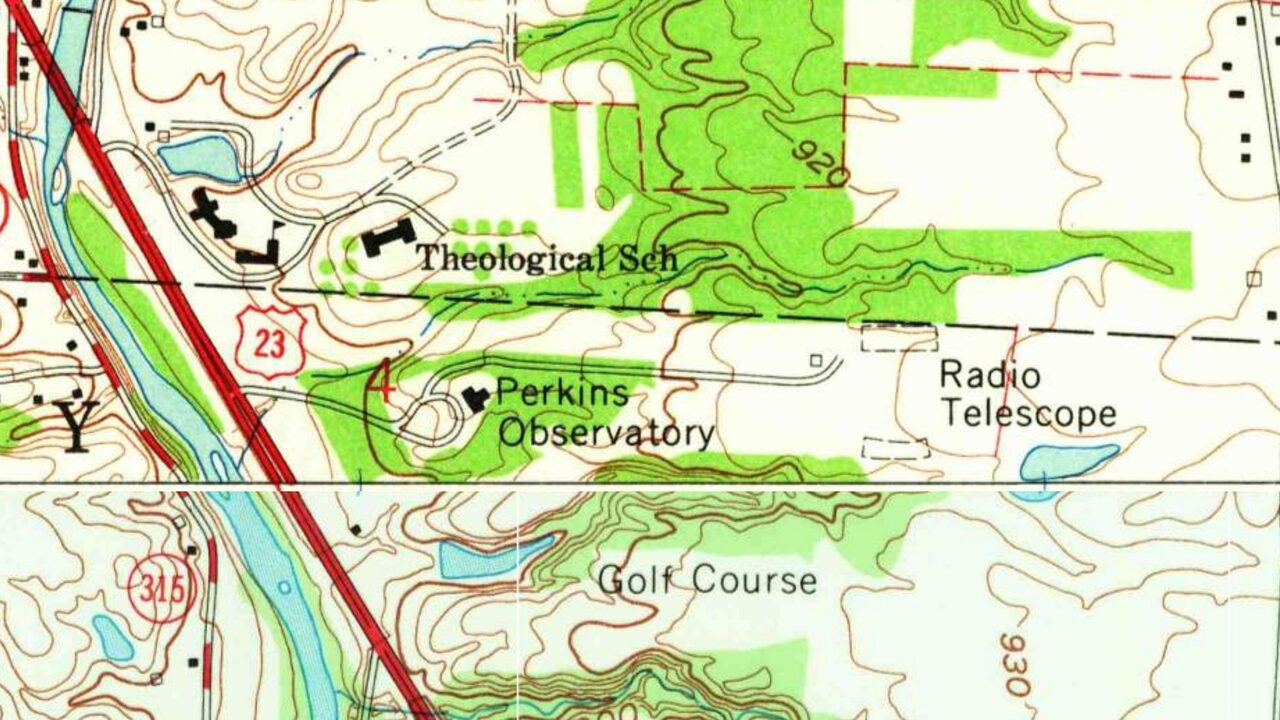
On December 28, 1982, Kraus got a phone call. Ohio Wesleyan had sold the land under the telescope, along with a good deal more, for half a million dollars. The buyer planned to stretch the nine-hole course next door to eighteen holes, with about four hundred homes. Ohio Wesleyan's officials had been under the impression that Ohio State meant to abandon the telescope.
Supporters sold Save Big Ear T-shirts, and Ohio State got a lease. The telescope kept listening.
The computer that printed the Wow did not make it. In the middle of the 1980s a mouse built a nest in its disk drive's air intake, and the drive destroyed itself. IBM said the machine was too old to be worth fixing. Dixon wrote up the loss himself: the old IBM computer came to a premature death at the hands of a mouse.
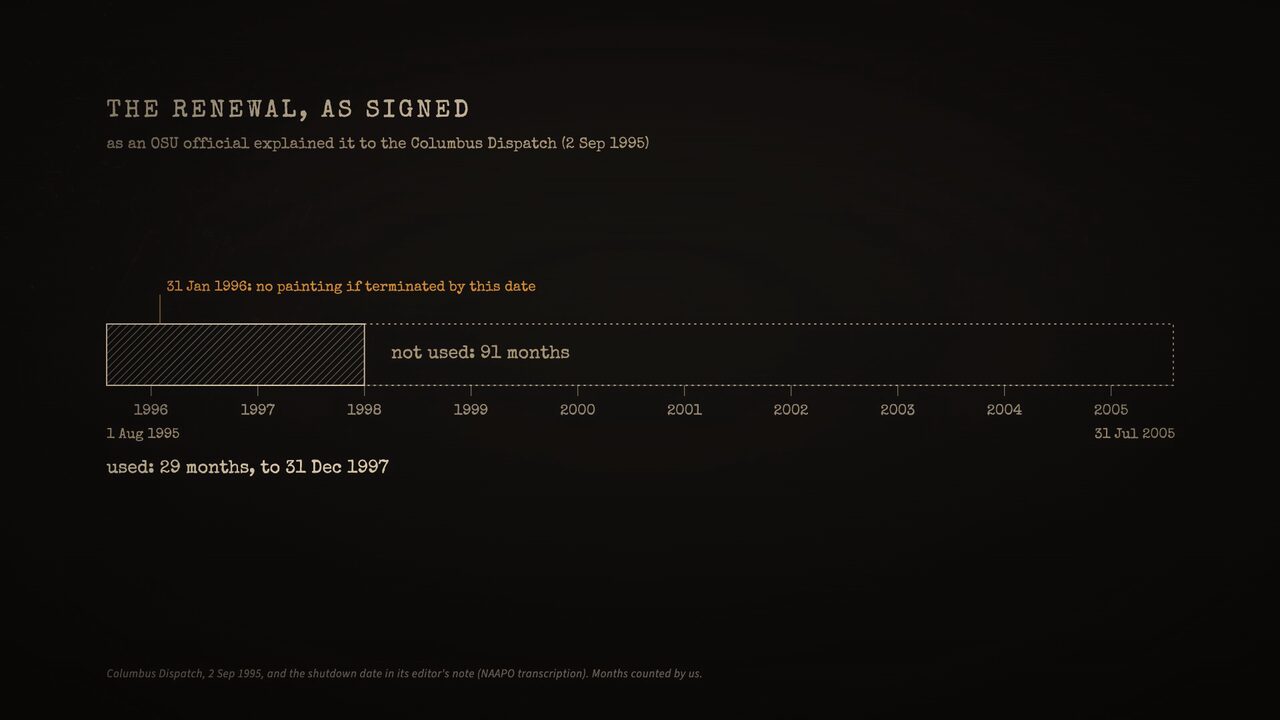
When the lease came up for renewal in 1995, Arthur C. Clarke and Carl Sagan both wrote to the university. The renewal terms, the Columbus Dispatch reported, called for a fresh paint job. Preferably in golf course green. Kraus figured that stripping the old lead paint could cost more than building the reflectors had. Ohio State signed a ten-year extension anyway.
A university official explained the plan to the Dispatch. This is a renewal for the full renewal period, but nobody intends to go through with that.
Kraus, in his eighties by then, had his own summary. In a confrontation between golf and the exploration of the universe, the galaxy does not stand a chance.
The Big Ear went quiet at the end of 1997. The next spring a seventy-six-year-old contractor took the reflectors down in six sections of more than twenty-five tons each. He had never demolished anything that large. He told the local paper it went just like he expected.
The Comet That Wasn't
Radio astronomy does solve its mysteries. At one observatory in Australia a run of strange bursts turned out to be the microwave oven in the staff kitchen, opened before it had finished. The bursts only ever happened during office hours.
The Wow has been held up against that kind of answer for decades. One 2025 paper even went through Ohio's television stations from that August. Whatever made the Wow moved with the stars. Ohio's television stations stayed in Ohio.
In 2016 a researcher proposed two comets as the source. In 1977, he said, they had been passing through that part of the sky wrapped in clouds of hydrogen. A year later he reported that one of them, observed again, gave off a signal at the hydrogen line. A headline announced the mystery finally explained.
Dixon had already looked up where the comets actually were on the night of the signal. Ten degrees away at the closest — nearly an hour of sky, and the further one worse than that. His statement, dated the day before that headline, put it in two words. Nowhere near.
He also checked with a comet expert and a hydrogen expert. Neither knew of any comet ever seen at the hydrogen line. And a comet moves too slowly to show up in one horn and skip the other.
The Channels Ran Backwards
The best natural explanation so far comes from a team in Puerto Rico led by Abel Méndez. Going through old data from the Arecibo telescope, they found small, cold clouds of hydrogen giving off narrow, Wow-shaped blips about a hundredth as strong. They propose that in 1977 a burst of radiation, perhaps from a magnetar, hit a cloud like those. For a few minutes it would have shone about a hundred times brighter, working like a laser, in radio.
That would give you a narrow signal, from a fixed point, that happens once. It does not give you a sighting. No telescope has ever caught a hydrogen cloud doing it, and no trigger has turned up in that part of the sky. The only radio lasers of that kind anyone has ever seen were built by people. Observatories use them as clocks.
Then the same team went back to the Big Ear's own paper. A volunteer had spent eleven years photographing more than seventy-five thousand printout pages. In the pages from January 1978 they found two fainter look-alikes — already circled, decades earlier, by the Ohio team.
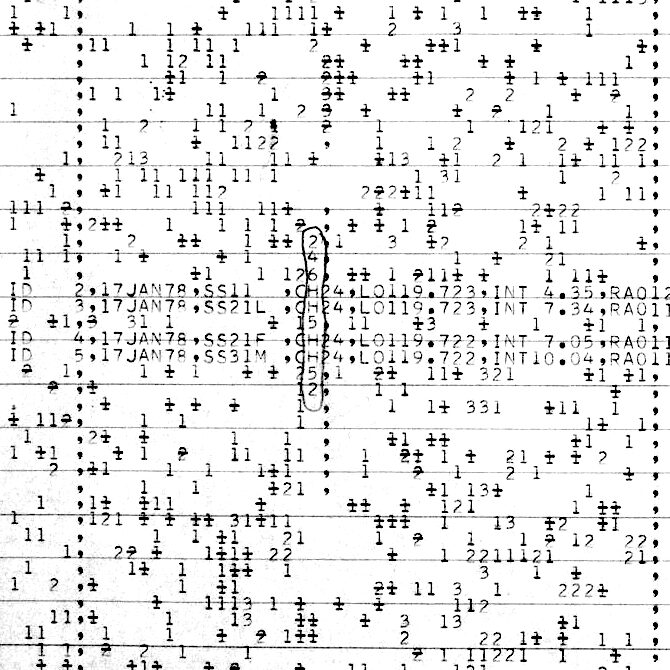
They also found that the receiver's channels ran in the opposite direction from what everyone had assumed. The famous frequency moved, and so did the spot in the sky. And the signal came out louder than anyone had thought.
Their paper, not yet published in a journal, concludes that the signal most likely came from the sky rather than from interference, and that it remains a phenomenon that requires further investigation. The project is called Arecibo Wow. The Arecibo telescope could never point at the Wow.
The Exclamation Point
Arecibo did send the Wow a reply, in 2012. It was a promotion for a National Geographic Channel series called Chasing UFOs. Viewers tweeted messages, and Stephen Colbert recorded a video assuring the aliens that we are not delicious.
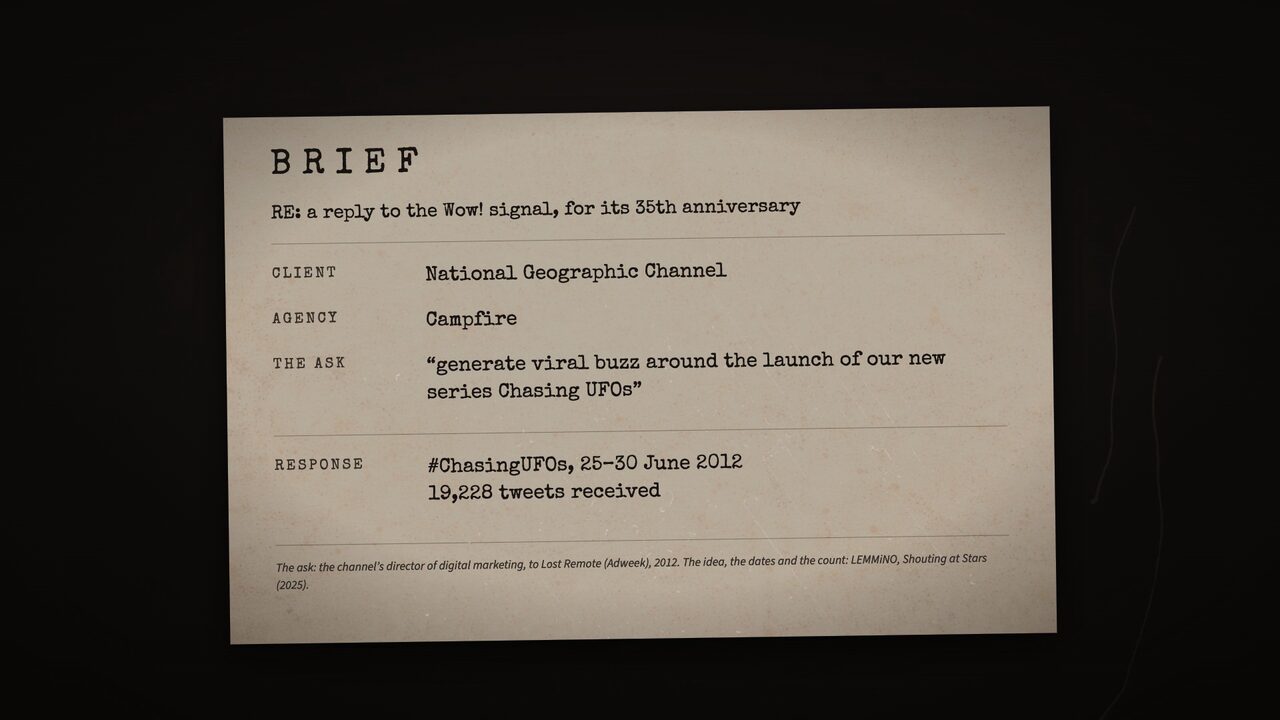
Arecibo beamed it all toward stars in Gemini and Cancer, on a different frequency. According to the observatory's director at the time, the transmitter overheated shortly after it started, and possibly only one message got out.
The printout ended up with the state historical society. Its online catalogue describes it like this: this signal may be the first record of contact with extraterrestrial intelligence; the Wow signal was also detected the night before the death of Elvis Presley; the Big Ear radio telescope was dismantled in 1998 to make way for a new golf course.
In 2002 the printout went on display beside an exhibit on White Castle. It was supposed to stay up about six months. The paper could not take the lights, and it went back into storage.
Ehman has never claimed proof. He has a rule about it: I choose not to draw vast conclusions from half-vast data. In July 2007 he walked the golf course with a Dutch film crew, looking for anything left of the Big Ear. They did not find a single pillar. A reporter along for the walk asked whether he believes in aliens. Yes, I do.
At the top of a rise a pond spread out in front of them. Ehman pointed south, toward where the signal came from. Over on another hole, the crew stopped to film a foursome hitting their shots. One of the golfers asked if they were filming a documentary.
Back in the archive, the printout has a column headed Object, for the name of whatever was in view. It was planned, but never implemented.

It still does not have one.
Sources & Case References
- Big Ear Radio Observatory / NAAPO — the Wow signal pages and printout scans
- Jerry R. Ehman, The Big Ear Wow! Signal (30th Anniversary Report), via bigear.org
- John Kraus, "We Wait and Wonder," Cosmic Search Vol. 1 No. 3 (Summer 1979), p. 33 — © Cosmic Quest, Inc., via bigear.org
- Giuseppe Cocconi and Philip Morrison, "Searching for Interstellar Communications," Nature 184, 844–846 (1959)
- Abel Méndez, Kevin Ortiz Ceballos and Jorge I. Zuluaga — the Arecibo Wow! project (2024)
- Abel Méndez et al. — Arecibo Wow! II (2025 preprint)
- Méndez, Dixon and Childers (2026) — the Big Ear archive paper
- Ohio History Connection — the Wow signal printout, catalogue entry
- UPI, "The Big Ear has had its moments of fame" (February 12, 1996)
- U.S. Geological Survey — Powell, Ohio 1:24,000 quadrangle, 1967
- Image credits: The Big Ear from the air — Méndez, Dixon & Childers, archive photo, photographer not credited, CC BY 4.0, source. The January 1978 printout page — Ohio SETI team (printout and pen oval, 1978), figure from Méndez et al. 2025, CC BY 4.0, source. Public-domain records courtesy the Big Ear Radio Observatory and the North American AstroPhysical Observatory (printout scans) and the U.S. Geological Survey (topographic sheets). Unmarked figures are frames from the film.