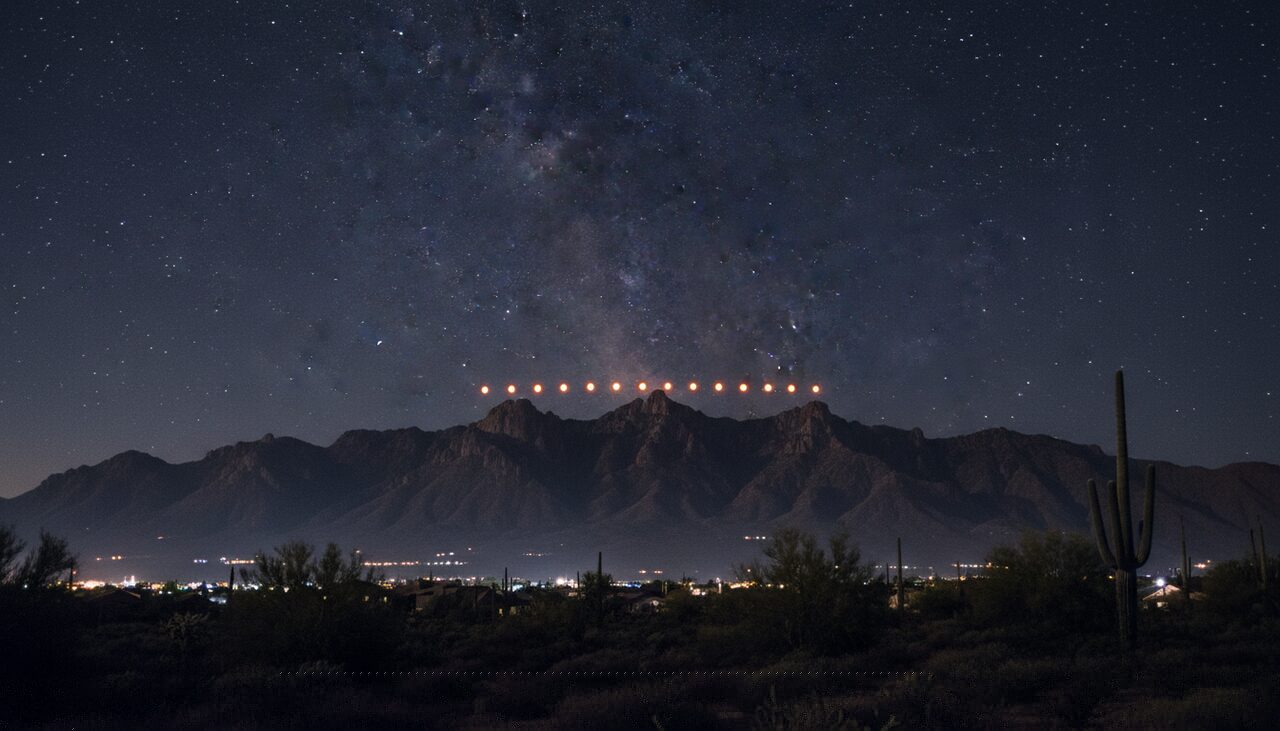
On the evening of November 17, 1896, between six and seven o'clock, people across Sacramento looked up and saw a light moving slowly westward, about a thousand feet overhead. Most saw only the light. A few reported something behind it — a vague dark body, long, carrying the lamp the way a hull carries a lantern.
A horse trainer standing in the agricultural park heard a voice come down out of the sky. What it said was: We are too low down here. Send her up higher.
The Wright brothers were seven years away and still in the bicycle business.
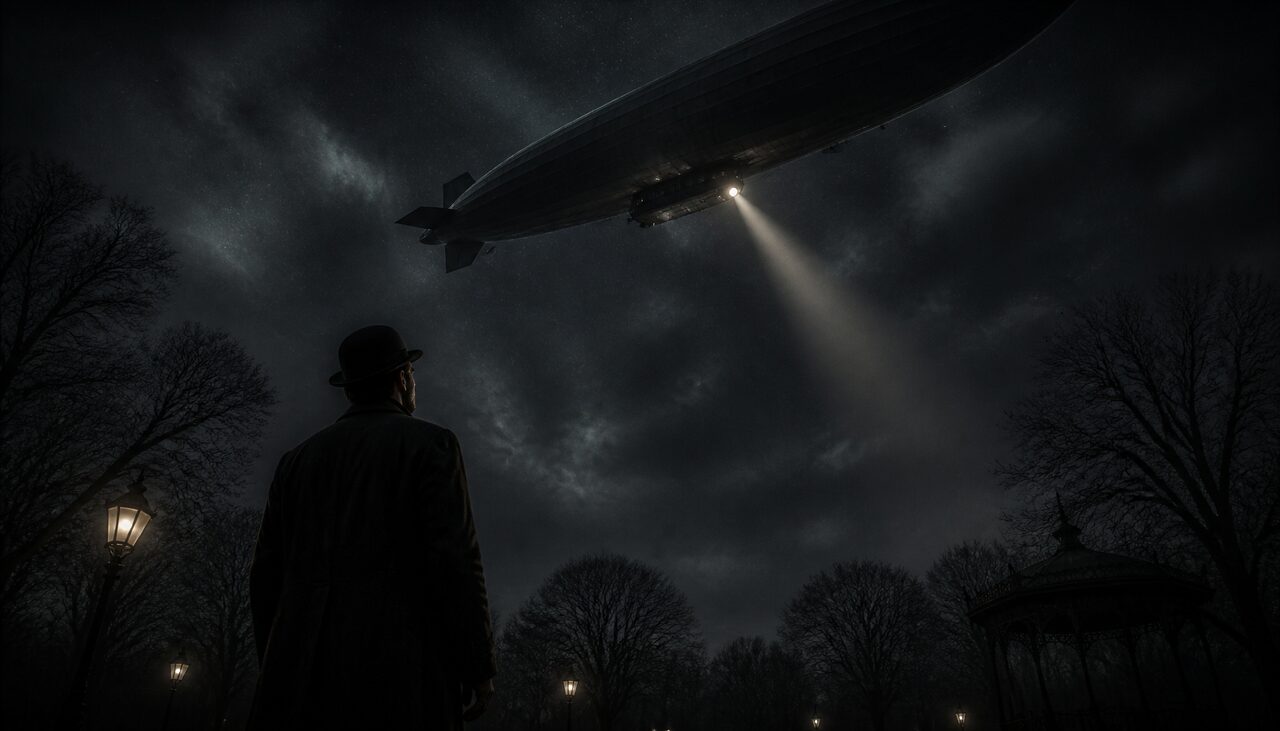
Over the following six weeks, newspapers placed the same craft over more than forty California towns. No machine was ever found. No inventor was ever produced. No patent was ever filed. What the record does contain is two attorneys, a former state attorney general, a flat denial from Thomas Edison, and a proposal to bomb Havana.
Lights Over Sacramento
The Sacramento Bee covered it the next morning with a straight face and a running start: "Last evening, between the hours of six and seven o'clock, in the year of our Lord eighteen hundred and ninety-six, a most startling exhibition was seen in the sky." That is how a newspaper writes when it suspects it has the story of the decade and is not entirely sure it wants it.
It helps to remember what 1896 felt like. Every few months a paper announced some new marvel, and the one marvel everybody was waiting for was a machine that could fly. So when a light crossed the sky with evident purpose, nobody's first thought was a ghost. It was that somebody had finally won.
A railroad colonel named Menton said the light was far brighter than the electric lamps in the park below him. A man described as a gentleman of undoubted veracity put numbers on it — shiny metal, 25 feet across, 150 feet long, with wings and what appeared to be propellers.
Five nights later it came back. This time there were two lights fixed to the same dark structure, witnesses said it was egg-shaped, and they said parts of it moved. Hundreds of people stood on street corners and watched it pass. In 1896, standing on a corner watching a light was the entertainment.
A Merry Chorus
The horse trainer's name was David Carl, and the voice he heard came attached to the rest of a conversation. The conversation was entirely about logistics. The occupants, he said, were anxious to reach San Francisco before midnight.
Humanity's first encounter with controlled flight, and the dispatch from inside the cockpit was that they were behind schedule.
A former streetcar man named Lowery gave the most detailed account. He also heard the order to climb — this time, he said, to clear a church steeple. Then he corrected himself. There were no churches nearby. The captain, he decided, must have meant the tower of the brewery. In Sacramento, the brewery was the landmark you navigated by.
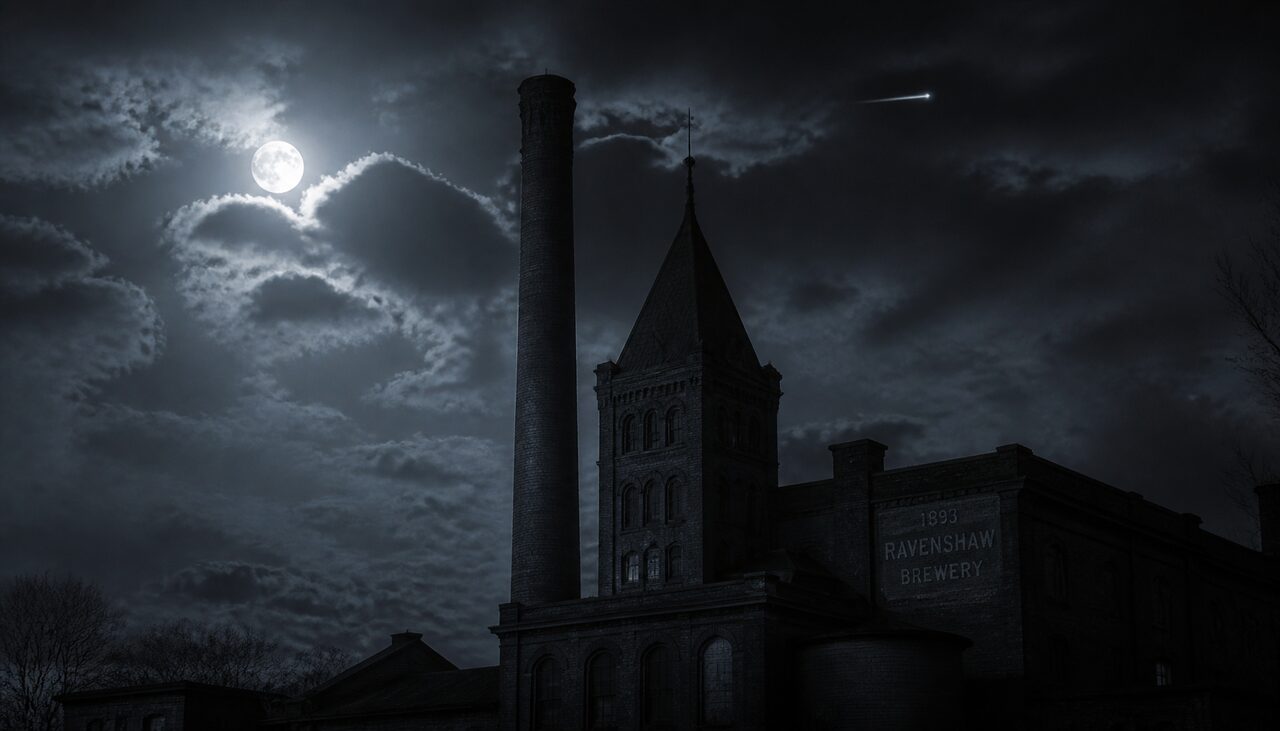
Then there was the singing. A brewery worker named Wenzel said the occupants were trolling a merry chorus that, though distant, sounded sweet and clear in the evening air. A whole streetcar of passengers agreed that someone up there was singing but could not make out the tune. It came, one of them said, in broken snatches, as though borne on gusts of the night wind.
What unsettles about the Sacramento voices is not that they are dramatic. It is that they are so dull. No message for mankind. No warning, no threat, no proclamation. The occupants discussed altitude, steeples, and their arrival time — the conversation of any crew on any vehicle running behind. A person inventing aliens to sell newspapers would have given them better lines.
Apparition of the Air
By the end of November the thing had crossed to the Bay, and the descriptions held together. Different towns, different witnesses, no telephone lines between most of them, all reporting the same long hull and the same wandering light.
The San Francisco Call gave it most of the front page. On November 24 the headline read, simply, "Apparition of the Air." The Call also floated a theory about who was responsible. Its leading candidate was Thomas Edison, who had not been consulted.
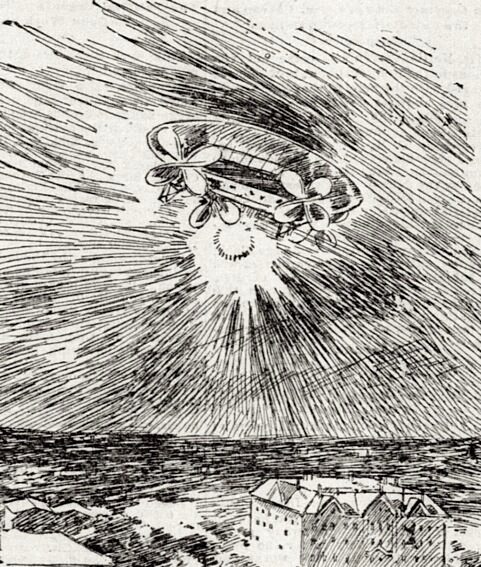
The Bay Area witnesses were, again, the respectable kind. Policemen. Streetcar drivers. A car-barn foreman and his entire crew. Adolph Sutro, the mayor of San Francisco, vouched for two of his own servants who had seen the lights and offered his professional opinion: "I certainly think that some shrewd inventor has solved the problem of aerial navigation." He was about to be half right.
The wilder the wave got, the wilder the accounts got. Near Lodi, a man named Shaw was driving out to the Fresno citrus fair with a companion when, he said, they came upon the thing sitting on the ground beside a canal. Three beings stood next to it, nearly seven feet tall and thin to the point of frailty. They made a warbling sound and pointed at the sky.
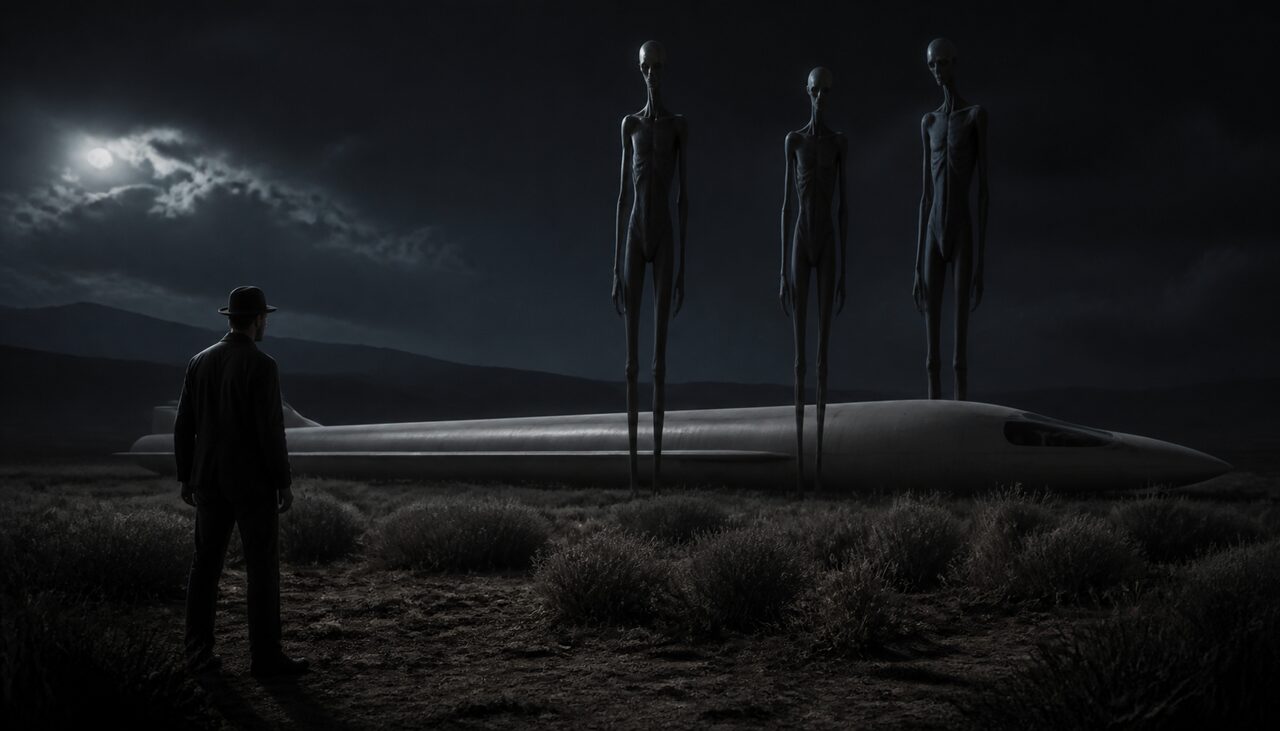
Then, Shaw said, they took hold of him and tried to lift him off the ground, and could not. They were not, by his account, strong enough to carry a grown man. So they gave it up, climbed back aboard, and left. Shaw's own conclusion was that they were Martians sent to secure one of Earth's inhabitants, and that they had selected one who weighed too much. Nobody could confirm a syllable of it. The paper ran it anyway.
Airship Collins
George Collins was a patent attorney in San Francisco. He told the Call, on the front page, that he represented the inventor — a millionaire who had come west from Maine, settled near Oroville, shipped his parts in quietly from the East, and sunk a hundred thousand dollars into a flying machine.
He had specifications, which was more than the witnesses had. A hundred and fifty feet long. Built of metal. Two canvas wings of eighteen feet each. A rudder shaped like a bird's tail. Room for fifteen passengers. Collins said he had personally watched it rise about ninety feet into the air under perfect control. He simply could not, at that moment, say where it was.

Pressed for a name, Collins eventually produced one: a doctor, a non-practicing dentist named Benjamin. Reporters went to Benjamin, whose response is one of the cleaner denials in the record. "I only wish I was the inventor." The Chronicle began calling the attorney Airship Collins. It was not meant kindly.
When no inventor appeared, and no machine, and no patent, the press turned on him. Collins changed his story, then stopped telling it, then reportedly left town to be somewhere the reporters were not. That would have been the end of it, except that W. H. H. Hart, the former attorney general of California, decided to get involved.
Hart had run the state's legal affairs. Now he announced that he represented the inventor, and that Collins had been dismissed for talking too much. Hart then talked considerably more. There were, he explained, two airships. A third, much improved, was under construction. The inventor flew home each night and hid the machine in a barn.
Hart also had a use in mind for it. Cuba was at war, and Hart proposed that the finished airship be flown to Havana and used to drop dynamite on it. "I believe that by means of this airship a great city could be destroyed in forty-eight hours."
In roughly three weeks the story had gone from a light over a brewery to a former attorney general pitching aerial bombardment to the newspapers. Nobody asked him to. No physical evidence was ever produced. What was produced was two lawyers, a dentist who denied everything, a barn, two imaginary airships, and a plan for aerial war against Cuba. The machine never materialized. The paperwork around the machine was extraordinarily productive.
Pure Myth
The skeptics had been talking the whole time. Edison, asked directly, wanted nothing to do with it. "Absolutely absurd." A practical airship, he said, was years off, and the things people were describing would only ever be toys. The most famous inventor alive, and his contribution to the invention story of the year was to ask everyone to please stop.
Then the press turned on itself. On December 5, William Randolph Hearst's Examiner ran an editorial calling the whole business fake journalism and the airship pure myth. Hearst accusing a rival paper of sensationalism is the sort of sentence that should come with a chair to sit down in. He also had a point. An airship sold papers, and a fair share of the singing and the Martians is probably just ink.
The ordinary explanations are real ones. A bright light in the night sky is very often Venus, which appears to drift when you stare at it. And in 1990 the researcher Robert Bartholomew laid the whole wave out as mass hysteria, each new sighting seeded by the last one printed. What that explains less well is the first night. Before the papers had printed anything to copy, a railroad colonel, a streetcar crew, and a horse trainer in Sacramento all looked up at the same light. Hysteria explains the echo. It has more trouble with the first sound.
A Windmill Demolishes It
All of which settled the matter completely, and then the following spring the entire country did it again. Beginning in April 1897, a second wave rolled out of the Midwest and across the South — well over a thousand newspaper articles in more than forty states. California had produced a light and some singing. The Midwest went considerably further.
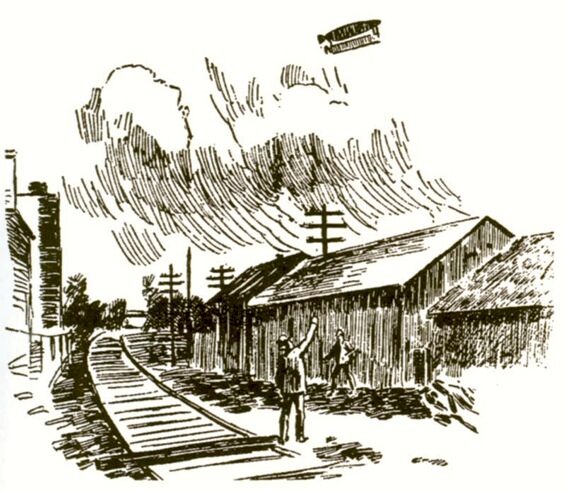
On April 17, a Dallas paper ran a dispatch from Aurora, Texas, filed by a local correspondent named S. E. Haydon, under the headline "A Windmill Demolishes It." The airship had come in low over the public square at about ten miles an hour, struck the tower of Judge Proctor's windmill, and exploded.
Wreckage over several acres. Papers aboard written in hieroglyphics nobody could decipher. The windmill wrecked, the water tank wrecked, and the judge's flower garden destroyed. And a pilot, badly disfigured, of whom the paper said only that enough had been picked up to show that he was not a native of this world.
The town gave him a funeral and buried him in the Aurora cemetery. There is a Texas historical marker standing there today. It mentions the airship.
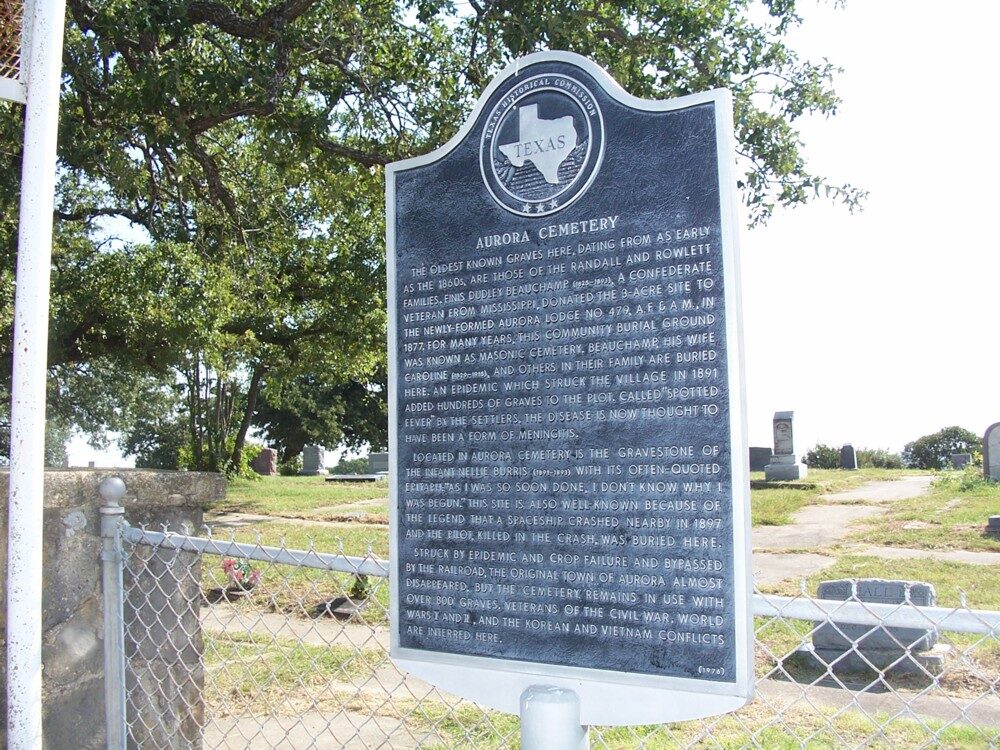
The grave had a stone, and in 1973 investigators found it, photographed it, and reported a shape cut into its face that resembled a craft. Shortly afterward, the stone was gone. Aurora was dying, and the marker says so itself — struck by epidemic, then crop failure, then bypassed by the railroad. A town in that condition has every reason to acquire a spaceman.
That same month, in Le Roy, Kansas, a rancher named Alexander Hamilton reported that the airship had come down over his cattle pen at about eleven at night. He said there were six occupants aboard. He said they lowered a cable, worked it around one of his heifers, and hauled her up into the sky, which would make a Kansas farmer the first man in recorded history to lose livestock to an aircraft.
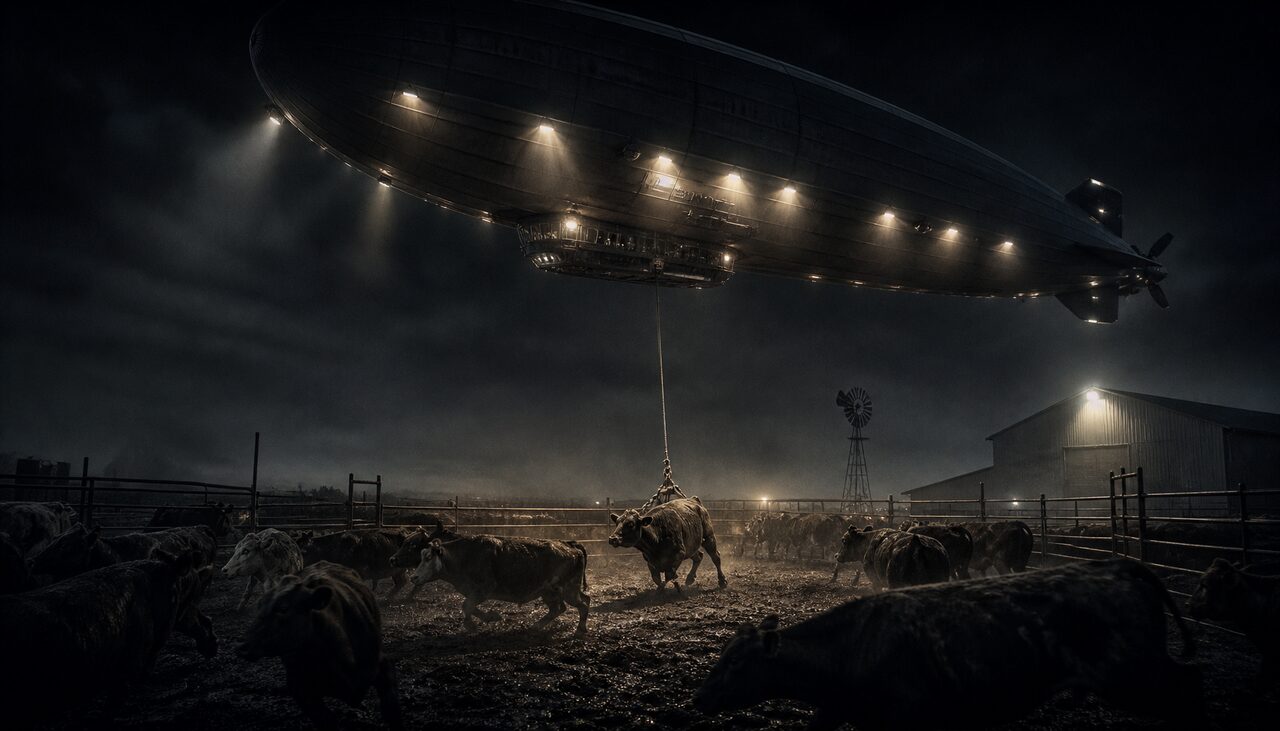
Hamilton did not simply tell it. He swore to it in front of a notary, and eleven of the most respectable men in the county signed a statement underneath. "For truth and veracity, we have never heard his word questioned." The sheriff signed. So did the banker, the doctor, and the justice of the peace.
The story ran across the United States and then across Europe. Alexander Hamilton belonged to a local club whose members competed to tell the largest possible lie. He won. It took about eighty years for anyone to check.
Before Midnight
Which leaves Merkel, Texas. On a Sunday night in late April, people walking home from church found a rope dragging along the ground. They followed it. It ran up into the dark toward a ship with light in its windows, and it ended in an anchor, caught on a railroad rail.
A small man in a light blue sailor suit came down the rope to free it. When he saw the crowd standing around his anchor, he stopped, cut the rope below himself, and rose back into the dark. The anchor went on display in the local blacksmith's shop, where it drew hundreds of visitors.
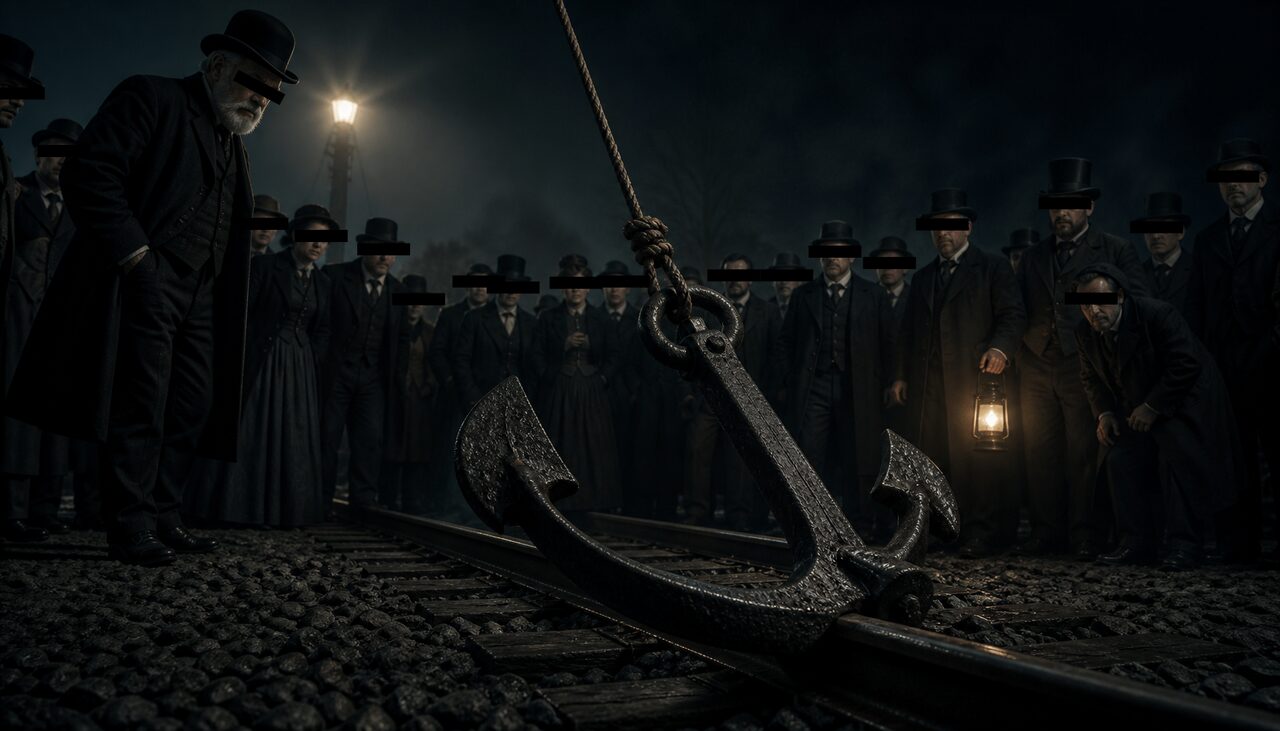
A ship in the sky. An anchor caught on the ground. A crewman climbing down to free it and cutting himself loose the moment he is seen. That story is not from 1897. It turns up in medieval Irish and Norse chronicles, set at a monastery called Clonmacnoise, centuries before anyone in Texas was born, in very nearly the same words. So either a Texas newspaperman had been reading medieval Irish manuscripts, or it is simply a story that people keep having.
Historians file the whole business where it belongs — America's first great wave of sightings in the sky, half a century before anyone said the words flying saucer. A rehearsal, in Victorian dress, for everything that came after. And seven years before the Wright brothers, nothing on Earth could do what hundreds of sober people swore they watched it do.
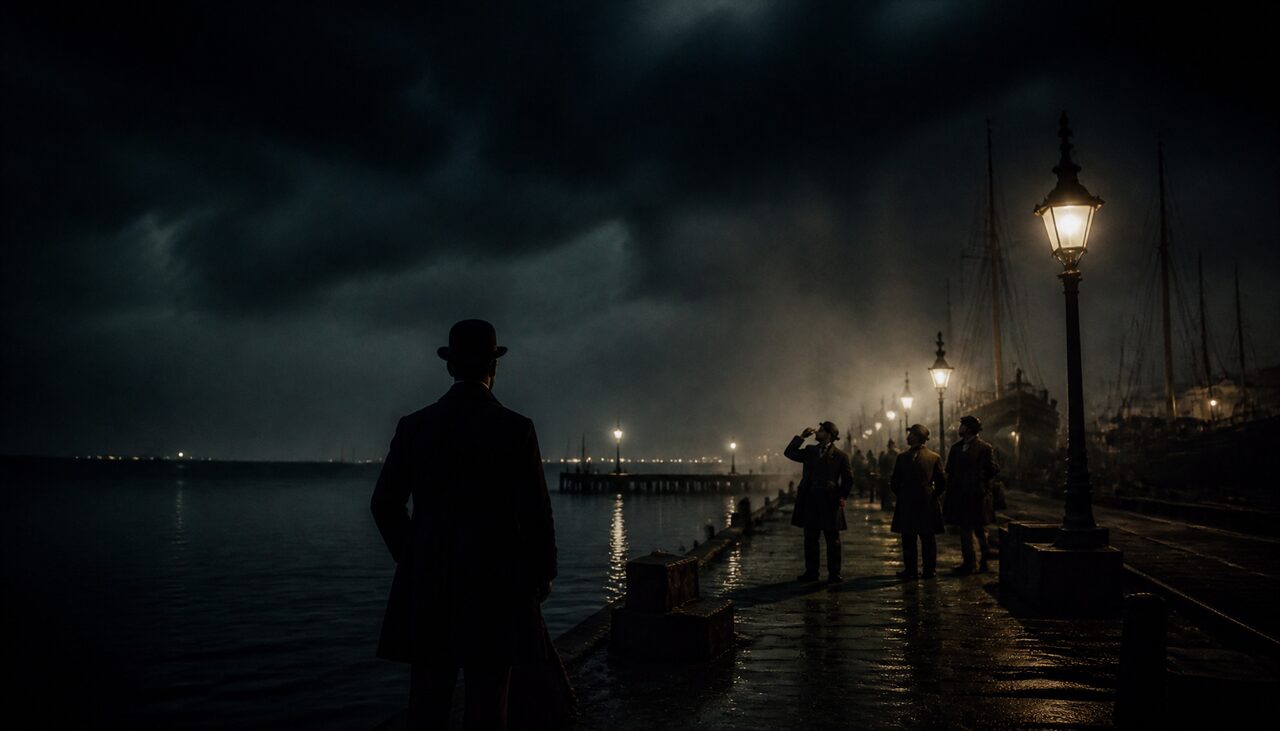
The crew, you will remember, were trying to reach San Francisco before midnight. They were late, and lost, and singing about it. Then the light went out over the Bay, and the file went cold. No one ever found out whether they made it.
Sources & Case References
- California Digital Newspaper Collection (UC Riverside) — San Francisco Call, November 23, 1896
- Chronicling America, Library of Congress — San Francisco Call, November 1896
- Texas State Historical Association, Handbook of Texas — "Aurora Airship"
- S. E. Haydon, dispatch from Aurora, Texas, Dallas Morning News, April 17, 1897
- Robert E. Bartholomew, "The Airship Hysteria of 1896–97," Skeptical Inquirer (1990)
- Daniel Cohen, The Great Airship Mystery: A UFO of the 1890s (1981)
- Archival images: San Francisco Call airship engraving (1896), 1897 airship engraving, and the Aurora cemetery marker — via Wikimedia Commons, public domain.