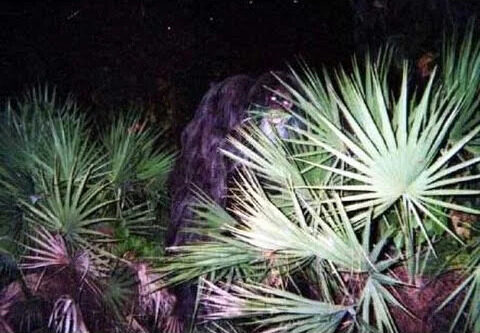
In the winter of 2000, somebody at the Sarasota County Sheriff's Office opened an envelope. Inside were two colour photographs and a letter from a woman who would not give her name. The office filed them.
Twenty-six years later they are still the best skunk ape evidence anybody has.
Florida has its own Bigfoot. It lives, reportedly, out in the saw grass and cypress of the Everglades — tall, hair-covered, seen for generations by hunters, hikers, and people driving back roads at night. Most witnesses do not lead with what they saw. They lead with the smell: rotten eggs and wet fur, arriving before the animal does. Bigfoot leaves footprints. Nessie leaves a wake. This one leaves a stench.
Orangutan on the Porch
Take the photographs on their own terms first. The animal fills most of the frame. Whoever pressed the shutter was close, in the dark, shooting into the palmettos with a flash. Its mouth is open. The eyes come back at the camera the way an animal's do. There is hair on the shoulders and down the arms, and the build sits heavy and low, and wrong for a person in a coat.
The letter is where it gets strange. The writer said her daughter had brought apples down from up north, and something had been coming onto the porch at night and taking them. On the third night, she got the photographs.
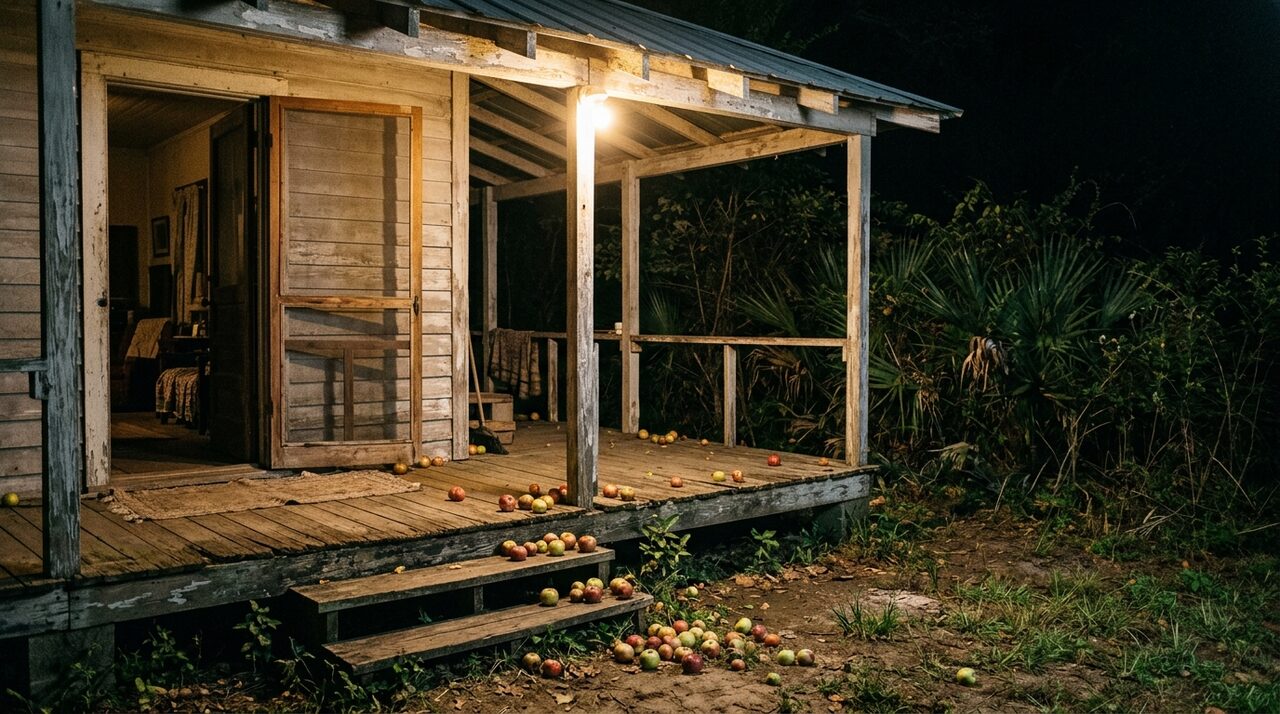
She and her husband had concluded it was an orangutan that had got loose somewhere. She wrote in so that somebody could catch it before it got hurt, or before it hurt anybody. Afterwards her husband set four more apples out to get a better look, two of them cut in half. It took the whole ones and left the halves.
She signed off as a senior citizen who thought the animal belonged somewhere like Busch Gardens, where it could be looked after properly, and asked to remain anonymous. Nobody has ever identified her.
Her theory holds up better than it has any right to. Orangutans have long reddish hair, an enormous arm span, and a heavy low build, and they weigh roughly what a person does. Florida in 2000 had roadside zoos, private collectors, and a famously relaxed attitude to exotic pets. A loose orangutan in Sarasota County is not the strange part of this story.
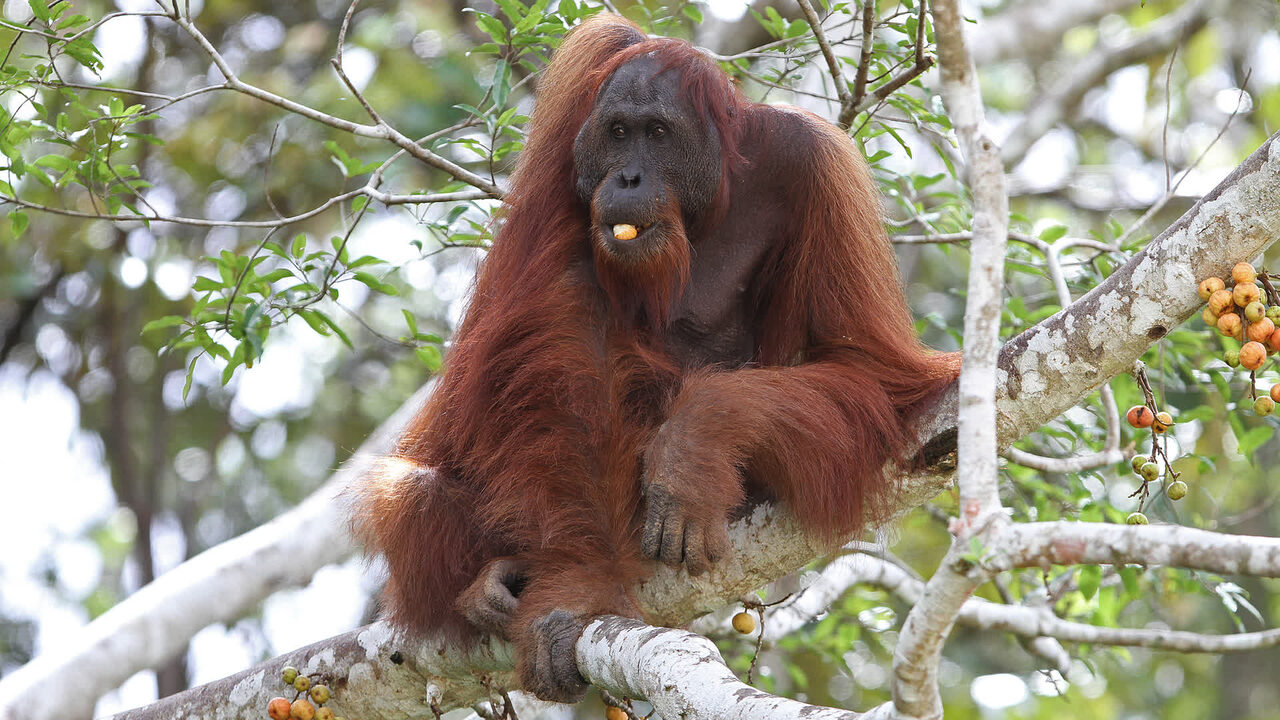
The letter even asks whether somebody is missing one. Nothing in the available record answers that — which is not the same as nobody ever having reported one, only that no search of the sheriff's or animal-control files has been produced either way.
The people who looked hardest could not agree on what they were looking at. Some saw a real great ape. Some saw a costume good enough to pass. Some saw proportions that were subtly wrong, in the way a person in a suit is subtly wrong. Twenty-six years, the same two frames, no settled answer. Nobody has proved them fake. Nobody has proved them anything else either.
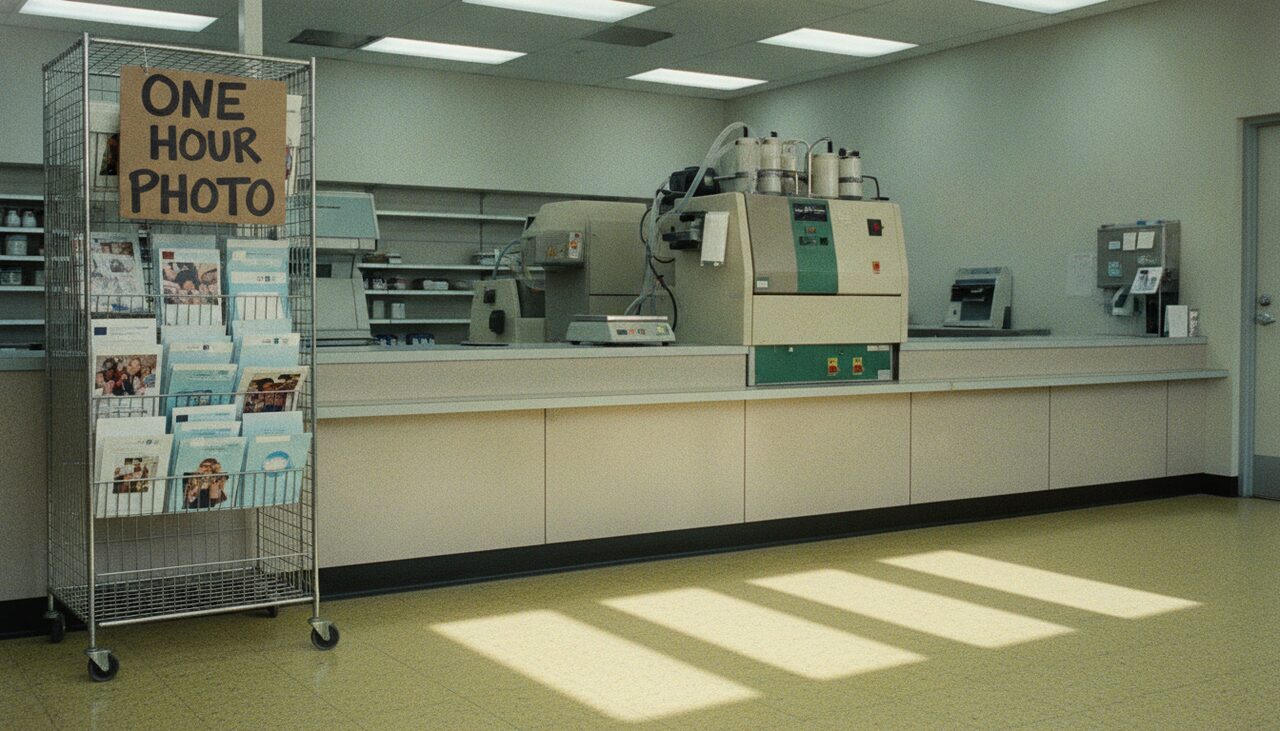
The photographs wound up with a Sarasota man named David Barkasy, and through him with the cryptozoologist Loren Coleman, who published them. They have been the Myakka photographs ever since, after the river nearby. By Coleman and Barkasy's account, the trail runs back as far as a one-hour photo counter at the corner of Fruitville and Tuttle.
Rabies Control
The apples were not the first time. In 1818, newspapers carried a story out of what is now Apalachicola about a man-sized monkey raiding food stores along the coast and following fishermen on the shore. Florida's ape problem is older than Florida. That one comes down to us through retellings rather than a clipping anybody has produced recently, and it is worth holding a little loosely.
The reports keep the same shape for a century and a half. 1929, an apelike animal around a construction site in the Keys. 1957, hunters report something walked into their camp — not attacked it, walked into it. In most of these accounts the animal is far more interested in the food than the people. It behaves like something going through your cooler.
Then came the 1970s. In August 1971, children at a trailer park in Broward County told their parents they had seen two of them at the edge of the lot. By that evening, men with guns were walking the palmettos. In Fort Lauderdale the witness statements went to the county rabies control officer, a man named Henry Ring. What people described to him was big and hairy, with small eyes, a monkey's face, long arms, and grey blotches across the body. Which is how Florida's monster became, officially, an animal control matter.
Then, just after midnight on the ninth of January 1974, a man named Richard Lee Smith hit something with his car. He was on Highway 27 near the Hollywood Boulevard intersection, where the road runs along the eastern edge of the Everglades. Smith told the Highway Patrol he thought at first he had hit a tall man in dark clothing. Then it got up off the road. He said it was seven or eight feet tall and covered in hair, that it roared at him and came at the car. Smith did not stay.
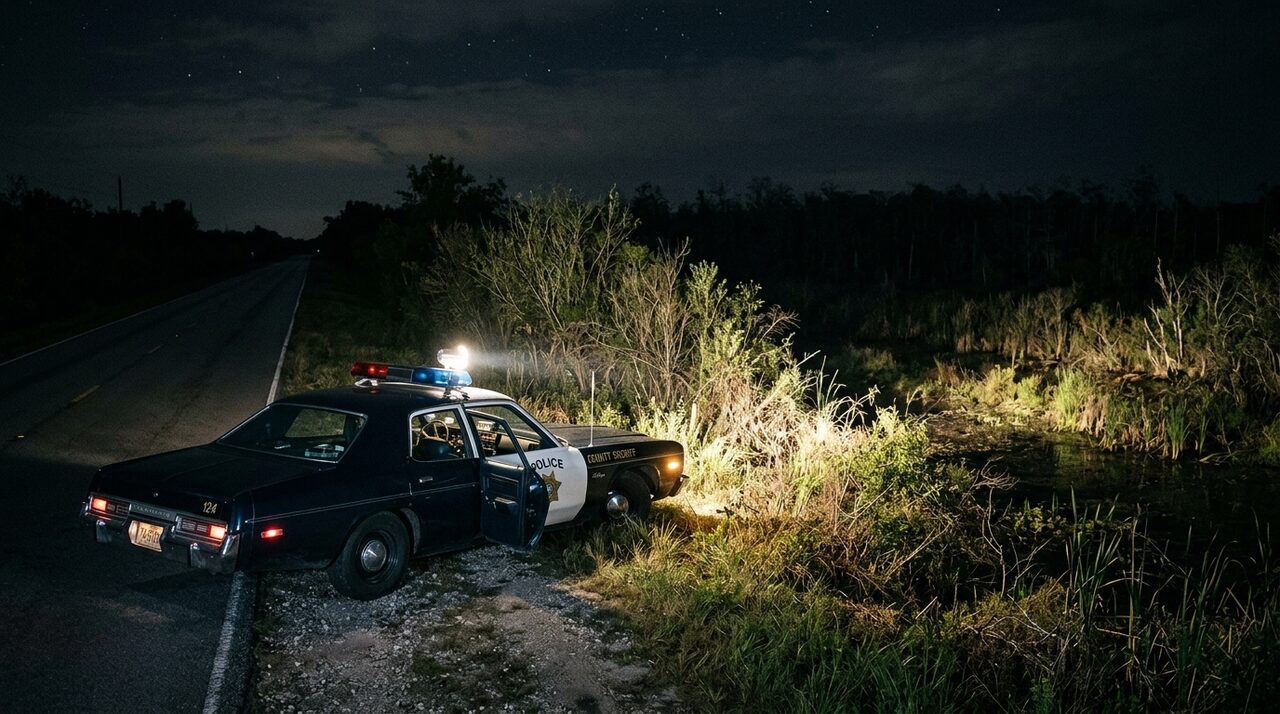
What stayed in the file is what happened next. Over the following two hours, other drivers on that stretch reported the same thing: something large, walking along the road, limping. At twelve minutes past two in the morning, a patrolman in Hialeah Gardens radioed in that he was looking at it — a big hairy animal, a few miles up from the crash, moving badly, before it went off into the brush. Posses went out through all of it. Nobody brought back a body.
Protection Act
In 1977 the Florida legislature took an interest. Representative Paul Nuckolls of Fort Myers filed a bill to protect it, and filed it again the year after. The file is still in the State Archives, under the name somebody typed on the folder: the Florida Skunk Ape Protection Act.
It provided, more or less, for a first degree misdemeanor penalty for a person taking, possessing, harming or molesting an anthropoid or humanoid animal native to Florida, which is also known as the skunk ape, big foot, sasquatch or whatever. The transcript notes that he then passed photographs around the committee.
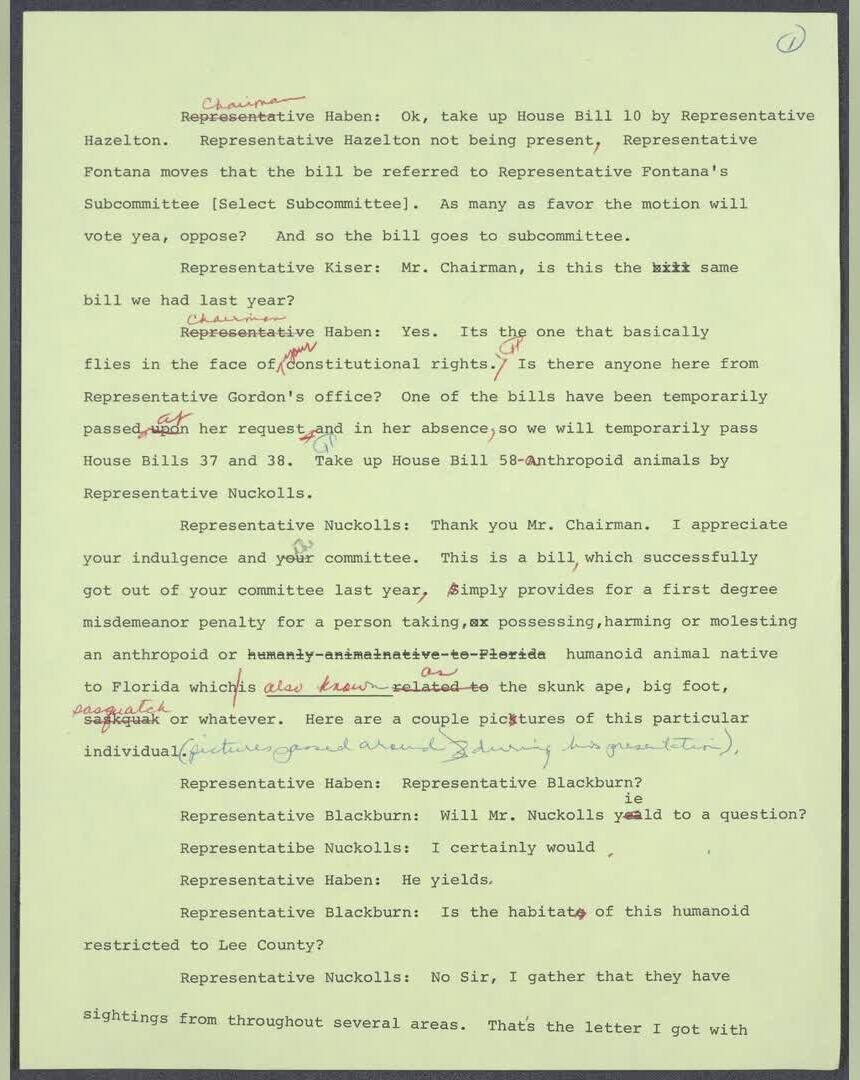
The questions are the best part of the file. Representative Blackburn asked whether the habitat of this humanoid was restricted to Lee County — Lee County being, as it happens, the district Representative Nuckolls represented. Representative Burrall was worried about something else. He said the problem was that this beast, if in fact it exists, was in danger of over-publication by the press and people searching for it, and that he was afraid it would go the way of the ivory-billed woodpecker if they did not do something to protect it.
A Florida legislator, in 1978, on the record, worried that Bigfoot might go extinct.
It cleared committee more than once. It never became law, and the archive's own catalogue says so — so the version where Florida came within a whisker of protecting an animal it could not produce is a better story than the record supports.
There is one more page worth reading. A letter entered into the record from a man in New Iberia, Louisiana. He had heard about the Florida skunk ape bill, and he was enclosing a few photographs, in the event that there might be a few skeptical Senators who needed a little convincing. Somebody always mails the photographs.
Lima Beans
In 1974, a ten-year-old named Dave Shealy went out deer hunting with his older brother Jack in the swamp behind their house. Their father had come across a set of tracks out there a few years earlier. What Dave says he saw that day looked like a man, but completely covered in hair. He has spent the fifty years since trying to see it again, and by his own count has managed it three more times.
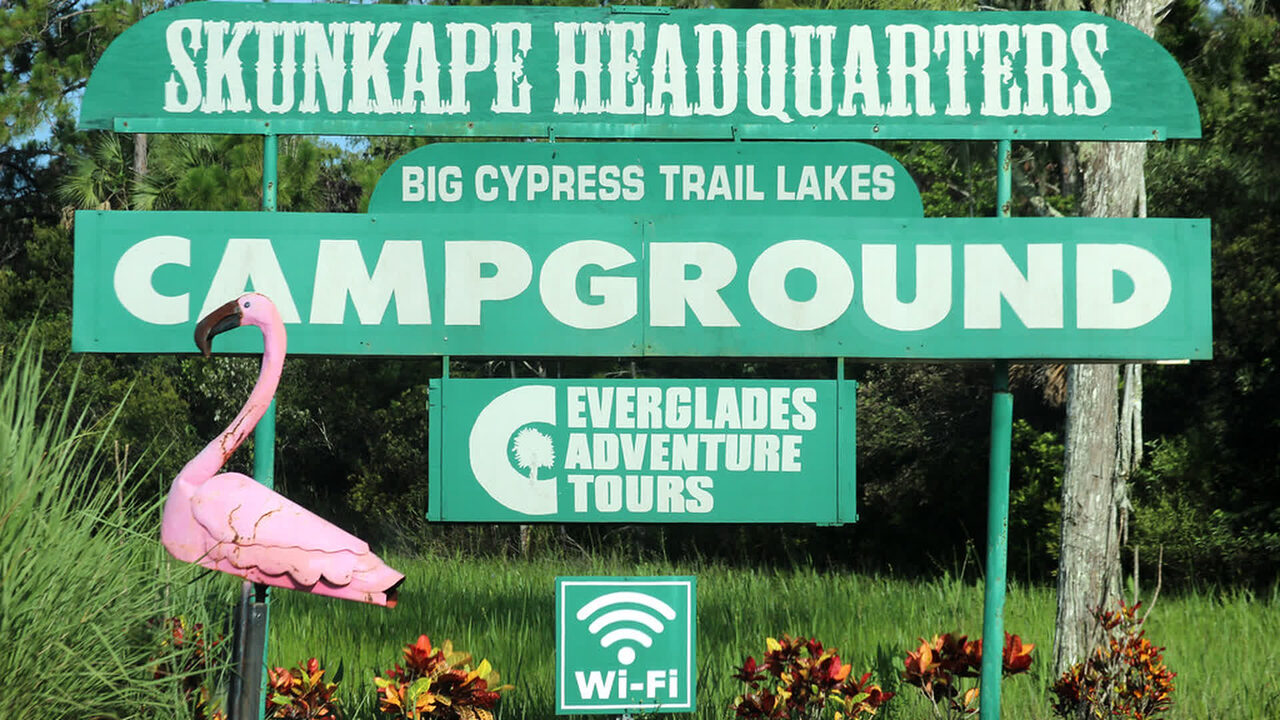
His headquarters sits on the Tamiami Trail in Ochopee, on thirty acres, with a campground, a gift shop, a reptile pen, five employees, and a hand-painted sign advertising Wi-Fi. He calls himself the state and county expert on the Florida skunk ape. There is no competing claim on the title, which, technically, makes him right.
He went looking for it with lima beans. Shealy's working theory is that the animal is an omnivore with a preference, so in the summer of 1997 he built bait stands out in the swamp and loaded them. He reports that the beans went overnight, repeatedly, and that there were tracks around the stands in the morning. Weeks later, a tour bus full of people said they saw a seven-foot animal in the same stretch of country.
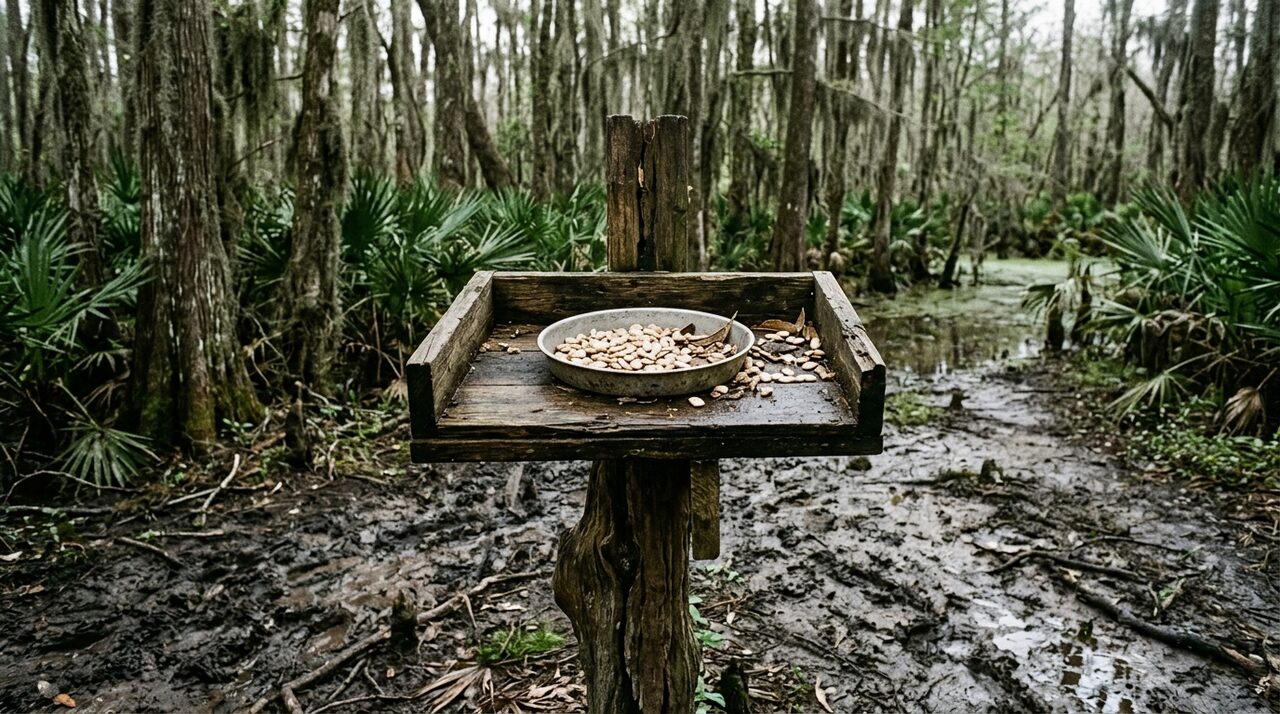
His published field guidance goes further. The animal stands six to seven feet. It spends about half its life in trees. And the lima beans, he specifies, work best wetted. Not soaked. Wetted.
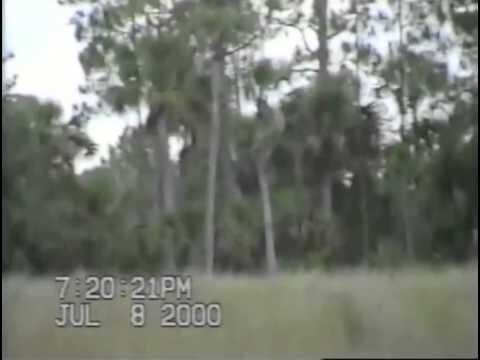
In July 2000 he got footage — a distant dark figure moving through a hummock of palms, shot from hundreds of feet away, which he clocked at about twenty-two miles an hour. It is distant, grainy and shaky. It has also been watched several hundred thousand times.
Plenty of Monkeys
Here is the part that makes the skunk ape more interesting rather than less. Florida really does have loose primates. Not folklore — actual monkeys, living wild, in the actual state, right now.
In the 1930s a boat operator on the Silver River put a handful of rhesus macaques out on an island to decorate a jungle cruise. Nobody had told him macaques can swim. They have been out there ever since, a couple of hundred of them now, up and down the Ocklawaha. A second group, vervets, got loose near Dania Beach in the forties and never left. The squirrel monkeys near Naples did not make it. The other two are still going, ninety years on.
Those are monkeys. An orangutan is a great ape, and the distinction is the whole argument. Florida does have captive great apes — there is a sanctuary up in Wauchula with orangutans and chimpanzees in it right now — but a macaque in a river is not an ape on a porch, and a sanctuary orangutan is not an escaped one. The animals are in the state. The photograph still needs identifying.
The swamp fills in the rest generously. Feral hogs, big and black and startlingly fast. Deer moving wrong in the dark. Burmese pythons past nineteen feet. Florida panthers, down to a few dozen animals at their worst. And the Florida black bear, which stands on its hind legs, swims, and climbs, and which at a hundred yards in bad light is a tall dark shoulder-heavy shape with no obvious muzzle.
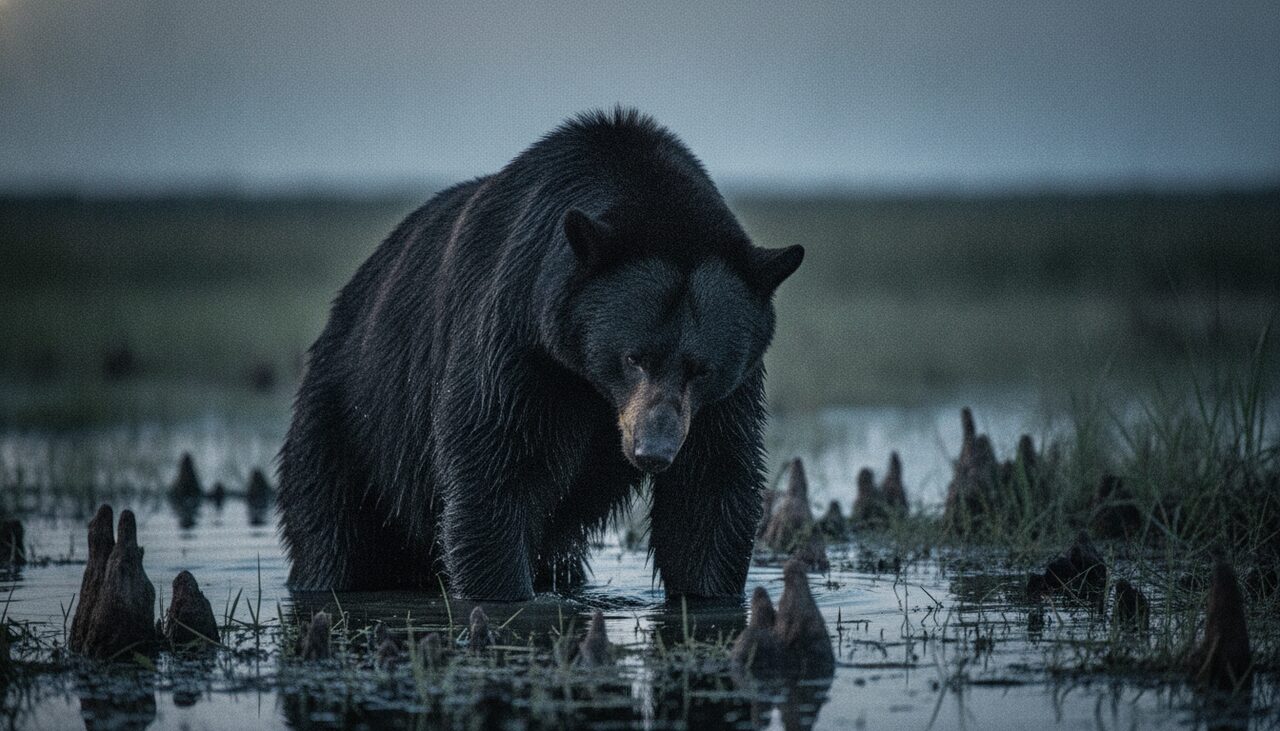
None of which rules anything out. It means only that the Everglades is already full of big strange mammals, any one of which can throw a shape into a flashlight beam. The swamp is not a blank space with one monster in it. It is crowded, and most of the crowd is real.
The Stench
Which brings it back to the smell. The letter writer said it had an awful smell that lasted well after it had left her yard. Shealy describes a wet dog and a skunk, mixed together. And that is the odd thing about the skunk ape's best-attested piece of evidence: it is the only one that has never once made it back to a laboratory. Fifty years of people gagging in the dark, and nobody has thought to bring a jar.
The Everglades is a vast, warm, slow-moving sheet of water with enormous quantities of plant matter rotting underneath it, year round. Rot makes gas. Hydrogen sulfide is the rotten-egg one, and the one you can smell; methane is the swamp gas, and it has no smell at all. The sulfide pools down in the muck and sits there until something disturbs it. Put a boot in the wrong spot and the swamp exhales at you.
That gives a rotten-egg smell, in the right place, on demand. It does not tell you what anybody saw.
Alligator dens may add to it. Gators dig their dens back into the bank and spend the hot part of the day down in them, and the water and muck around an occupied one goes warm and still and organic. There are stretches of that swamp that smell like something died in them, because periodically something has. You can pass within twenty feet of a den and never see the animal. You will know it is home.
Shealy has a theory of his own here. He has written that the animal shelters in underground alligator caves and picks the stink up in there — which means the world's leading skunk ape researcher agrees that what the skunk ape smells like is an alligator den. He just puts something in the den.
Hydrogen sulfide does one more thing worth knowing. At low doses it is the rotten-egg smell. At high doses it stops being a smell at all, because it deadens the nerve endings that pick it up. That is precisely why it kills people in confined spaces: they climb down, they stop noticing, and they do not climb back out. The Everglades never gets anywhere near those concentrations. It only ever gets bad enough to ruin an evening.
Big Cypress
None of which has slowed the skunk ape down. There is the headquarters, the campground, the merchandise, the festival, and a spot on the map you can drive to. A whole small economy out on the Tamiami Trail, built around an animal nobody has ever caught. Roswell with alligators.
Every version of this runs into the same problem. Decades of sightings in a state crawling with hunters, hikers, airboat tours, trail cameras, and now a phone camera in every pocket. No skeleton. No carcass. No photograph clearer than the two from Sarasota. The National Park Service position, from a Big Cypress spokesman, is that there has never been a substantiated sighting verified by Park Service wildlife staff — which is a very long way of saying no.
Believers will tell you the swamp is too big and too wet to ever give up a body, and they have a point. Everglades National Park alone runs a million and a half acres, Big Cypress adds most of another million, and almost nobody is in any of it. That is the one part of the case with real weight behind it. Something could be out there. It is only that every piece anybody can actually pick up turns out to be a bear, or a bean, or the weather.
So: a real swamp, real animals in it, two photographs nobody has ever matched to anything, and a bill that would have made molesting a skunk ape a first degree misdemeanor. Every piece of it checks out except the one that would settle it.
The Everglades is big enough to hide almost anything. And somewhere out past the boardwalk tonight, past the last porch light, there is a wooden stand on a post with a pan of lima beans on it. Wetted, the way the guide says. By morning they will be gone. They always are.
Sources & Case References
- Smithsonian Magazine — "On the Trail of Florida's Bigfoot—the Skunk Ape"
- State Archives of Florida — Bill File, House Bill 58, "The Florida Skunk Ape Protection Act," 1978 (Series s19, s19_b0517_f03)
- The Singular Fortean Society — "The 2001 Myakka skunk ape photographs"
- Transcription of the anonymous Myakka letter
- UF/IFAS — survey of Florida's free-ranging monkey populations
- Center for Great Apes (Wauchula, Florida) — FAQ
- USGS — hydrogen sulfide and sulfate reduction in South Florida peat
- National Park Service — American alligator, Everglades National Park
- Mental Floss — "Strange States: Florida's Skunk Ape"
- Image credits: the Ochopee headquarters sign is "Skunkape Headquarters" by Richard Elzey, CC BY 2.0. Orangutan photograph CC0 via Wikimedia Commons. The 1978 committee transcript is a Florida public legislative record, State Archives of Florida. The Myakka photograph and the frame from Dave Shealy's 2000 video are unlicensed and reproduced here as the direct subject of commentary. Unmarked figures are illustrations.